

Using a Local LLM to Drive a Chinese IME: An Experimental Project I Built
An experiment that uses a 350MB small model for context-aware ranking in an IME. The idea is actually more clear-headed than those things that just pile on parameters. But bro, stick with the Web version for now and don't rush to hype a native IME framework—wait until you can get typing latency under 100ms.
目录8 个章节
Starting from a Problem
Have you ever run into this while using an IME: you've typed a stretch of text, and in the candidate list for the next word, the one ranked first just isn't the one you want—but you know that word is a few spots down, because you just used it.
Traditional IME candidate ranking is essentially a word-frequency statistics system—it records "this is the word most commonly used by all users," not "this is the word you're most likely to use in this current passage." The gap between the two is contextual understanding.
This isn't an engineering problem; it's an architecture problem. Frequency tables are inherently incapable of understanding context.
And large language models happen to take contextual understanding to the extreme.
An Interesting Idea
When a large language model generates text, what it essentially does is: given all the preceding text, predict the probability of the next word appearing. It takes the entire context into account—what topic you were talking about, what style you used, which word you used in the previous sentence—all of these affect its predictions.
So what if we grafted this capability onto an IME?
The idea is actually quite straightforward: the user types pinyin, which acts as a filter; among all words that match that pinyin, let the LLM score them according to the current context, and rank the highest-scoring one first.
For example: you're writing an article about programming and type the pinyin ji. A traditional IME might give you 「几」「记」「技」「机」, because these characters all have high word frequency. But if the LLM knows you're talking about programming, it will give 「技」 (技术, technology) higher weight, because that's more natural in a programming context.
This isn't magic. It's a capability language models already have—it just hasn't been applied to the IME scenario before.
This project is inspired by lime, exploring a new approach to input methods: using a local large language model's language understanding to drive candidate ranking, rather than relying on a traditional N-gram statistical lexicon.
What Is llm-ime
llm-ime is an experimental project I built to implement the idea above and verify whether it actually works.
At its core is a Node.js service that loads a locally quantized GGUF-format model, accepts pinyin input, and returns candidates ranked by context. There's a companion Web Dashboard written in React, where you can type directly in the browser to experience the effect, and incidentally check input stats and engine status.
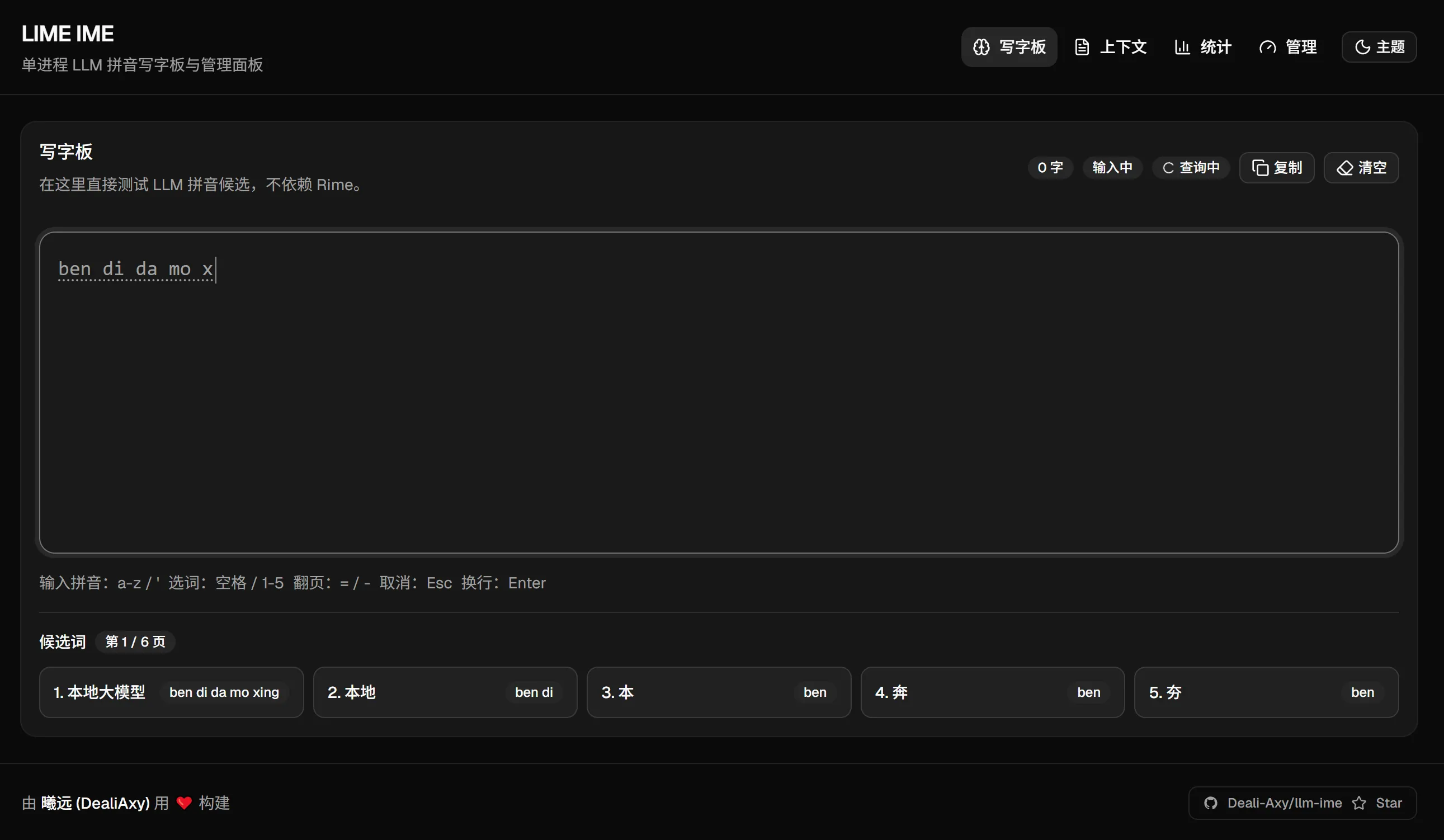
Important note: This is an experimental project, currently in the Web validation stage. I'm using a Web UI to verify that the engine logic and response speed meet the bar—not actually intending for you to use the browser as an IME. Once the engine is working, the next step is integrating with a real IME framework (such as RIME), or writing a native frontend myself.
What Model Is Used
Qwen3-0.6B-IQ4_XS, Alibaba's quantized 0.6B-parameter version, about 350 MB in file size.
Reasons for choosing this model:
- Small enough: 350 MB is entirely acceptable, unlike those large models that run to tens of GB and make people back away
- Fast enough: CPU inference can still produce results in seconds, so you won't be waiting so long you start questioning your life
- Accurate enough: The Qwen3 series is specifically optimized for Chinese understanding, and the contextual matching of candidates is better than you'd expect
The model runs entirely locally, with no network connection and no data uploaded whatsoever. Privacy is guaranteed.
A Brief Look at the Technical Implementation
For readers interested in the technical side, here's a brief overview of the implementation.
The whole project is a pnpm monorepo, split into three parts:
apps/server: LLM inference engine + HTTP API, serving endpoints with the Hono framework, using node-llama-cpp for GGUF model loading and inferenceapps/web: React frontend, TanStack Router + Tailwind CSS + shadcn/ui, with dark/light theme supportpackages/ui: Shared component library
A few architectural bits I find pretty interesting:
End-to-end type safety: Type sharing via Hono RPC. The server defines the routes; the frontend creates a client with hc<AppType>(), and request/response types are fully inferred automatically—no manual type definitions needed.
Lag-prevention design: Typing is a latency-sensitive scenario. LLM inference inherently has latency; if every keystroke triggered an inference and waited for the result, the typing experience would be terrible. The project has several layers of handling: the input display updates immediately on keystroke (synchronous, no delay), candidate requests are debounced before being sent, React's useTransition demotes candidate updates to low-priority rendering, the backend uses a version-number mechanism to skip stale queued requests, and the frontend uses AbortController to cancel already-sent old requests. With these layers stacked, typing basically doesn't feel laggy.
Fuzzy pinyin: Built-in initial/final fuzzy matching. Common mistakes like z↔zh, c↔ch, s↔sh, an↔ang, en↔eng are all tolerated, so you don't have to worry about typing too fast.
Quick Start
If you want to run it locally and try it out, the steps are simple.
1. Clone the project
git clone https://github.com/Deali-Axy/llm-ime.git
cd llm-ime
pnpm install
2. Download the model
The project provides a script that downloads only the needed file (350 MB), without pulling the full 20+ GB model repo:
pnpm run model:download
3. Start the services
# 终端 1:后端
pnpm run server:dev

# 终端 2:前端
pnpm run web:dev
Open http://127.0.0.1:5173, and you can start typing in the browser.
Current Status and Next Steps
Honestly, the current results still have quite a bit worth polishing. Candidate ranking is sometimes very accurate, and sometimes some weird words pop up—this has to do with the model's token granularity and quantization precision. Long-sentence prediction is also less stable than short phrases.
That's also why I chose to do Web validation first—in the browser you can see the engine's performance very intuitively, which makes it easy to tune parameters and improve the logic.
What I want to do next:
- Engine level: Continue optimizing the candidate scoring strategy, and improve the stability of long-sentence prediction
- Frontend level: Depending on plans, integrate with the RIME framework, or write a native IME frontend directly, so it can actually be used in everyday typing
- Model level: Explore quantization schemes better suited to this scenario, finding a better balance between speed and accuracy
Right now this is more of an "idea validation" stage. If you find this direction interesting, feel free to chat, or come straight to GitHub and open an Issue / PR.
Closing Thoughts
The starting point for this project was simple: I feel that when people talk about AI applications nowadays, it's always chat, RAG, Agent—but combining AI with more fundamental tools (like IMEs) is something few people seriously work on. The pinyin IME scenario is a natural fit for LLMs—there's a clear constraint (pinyin), rich context (the characters you've already typed), and immediate feedback (whether you pick that word or not).
The results were surprisingly decent. The 350 MB model performed better than I expected. Of course there's still a ways to go before it's truly usable, but I think this direction is worth continuing to explore.
The project code is open on GitHub. Stars, Forks, or Issues to share ideas are welcome:
🔗 https://github.com/Deali-Axy/llm-ime
If you're interested in AI tools, developer productivity, or interesting open-source projects, feel free to follow me: GitHub @Deali-Axy
_EOF_
Using a Local LLM to Drive a Chinese IME: An Experimental Project I Built
- 本文作者:
- 程序设计实验室
- 版权声明:
- 本博客所有文章除特别声明外,均采用 BY-NC-SA 许可协议。转载请注明出处!
相关文章
LLM探索:使用DeepSeek免费平替cursor
Cursor太贵?DeepSeek+Cline勉强能用,但token烧得比我还快。生成的代码bug一堆,还不如自己敲。32k上下文调整后总算不报错,效果嘛,也就那样。
2026-05-09 · LLM · 约 1 分钟
LLM探索:离线部署Ollama和one-api服务
离线部署Ollama?手动下载上传,导入模型文件,啧,麻烦。one-api用Docker,tiktoken需下载重命名,更烦。添加渠道?简单。
2026-05-09 · LLM · 约 1 分钟
LLM探索:为ChatGLM2的gRPC后端增加连续对话功能
给ChatGLM2的gRPC后端硬塞了连续对话功能,改了proto、C#客户端和Python服务端代码。OpenAI格式转ChatGLM格式?真够折腾的,幸好有loguru。搞定了,但调试gRPC还是麻烦,考虑改OpenAI接口了。
2026-05-09 · LLM · 约 1 分钟
ChatGLM-6B本地部署
下载项目代码 git clone https://github.com/THUDM/ChatGLM-6B.git 创建虚拟环境,建议使用 conda 管理 conda create -n chatglm python==3.8 安装依赖 conda activate chatglm pip install -r requirements.txt conda install cudatoolkit=
2026-05-09 · LLM · 约 1 分钟
讨论
共 0 条加载评论中…