

Two-Dimensional Bin Packing Problem with Multiple Constraints — Code Analysis for Finding the Optimal Layout of Cairo Ramen Shop (IV): Crossover Operator Analysis
Crossover Operators In common crossover operators, there is often an operation of selecting gene segments; some selections are continuous, and some are discontinuous. For crossover operators that use continuous selection, I always use circular selection. The specific operation is as follows: first given a start point l and an end point m, as well as gene length L, if l<m, then select the gene segment from l to m; if l>m, then select the two segments from 0 to m and from l to L. This ensures that every “base pair” has an equal probability of being selected. For the crossover operators I mainly referred to: https://blog.csdn.net/u
目录9 个章节

Crossover Operators
In common crossover operators, there is often an operation of selecting gene segments; some selections are continuous, and some are discontinuous. For crossover operators that use continuous selection, I always use circular selection. The specific operation is as follows: first given a start point l and an end point m, as well as gene length L, if l<m, then select the gene segment from l to m; if l>m, then select the two segments from 0 to m and from l to L. This ensures that every “base pair” has an equal probability of being selected.
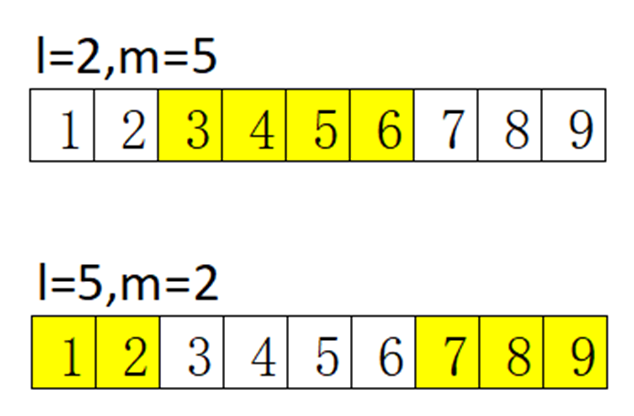
For the crossover operators I mainly referred to: https://blog.csdn.net/u012750702/article/details/54563515
Most of the following content is excerpted from that website, of course with a small portion of my own understanding.
Partial-Mapped Crossover(PMX)
This crossover operator uses continuous selection. The specific process is as follows: Step 1: randomly select the start and end positions of several genes in a pair of chromosomes (the parents) (the selected positions are the same on both chromosomes):

Step 2: exchange the positions of these two groups of genes:

Step 3: perform conflict detection. Based on the two exchanged groups of genes, establish a mapping relationship. As shown in the figure, taking the 1-6-3 mapping relationship as an example, you can see that in the result of step 2, offspring 1 has two gene 1s; at this point transform it into gene 3 through the mapping relationship, and so on until there are no conflicts. In the end, all conflicting genes will go through the mapping, ensuring that the newly formed pair of offspring genes has no conflicts:
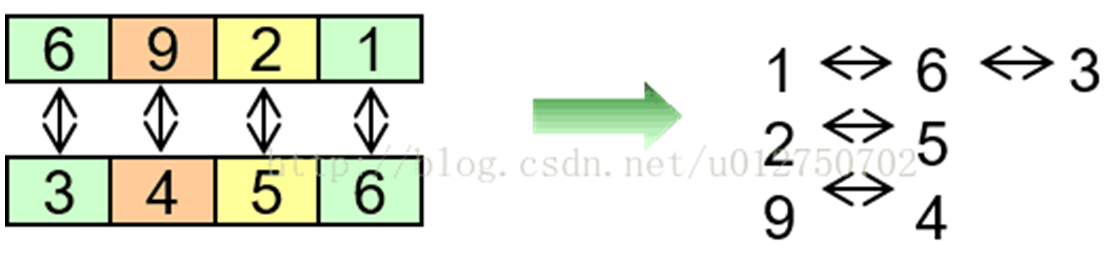
Final result:

The most critical part of this crossover operator is the conflict detection in the third step. The method I adopted is to first use a dictionary to store the “base” corresponding to each “base”. For example, in the above example, the dictionary I stored is
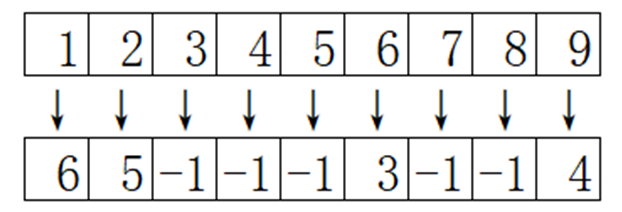
For such a mapping table, if I want to find the number corresponding to “1”, I only need nested loop checks: the number corresponding to “1” is “6”, the number corresponding to “6” is “3”, the number corresponding to “3” is “-1”, the loop stops, so I found that the number “1” ultimately corresponds to is “3”. In this way, conflict detection is implemented.
/// <summary>
/// PMX交叉算子
/// </summary>
/// <param name="parent1">父类基因一</param>
/// <param name="parent2">父类基因二</param>
/// <returns>基因片段</returns>
public static List<int[]> PMX(int[] parent1, int[] parent2)
{
    List<int[]> ans = new List<int[]>();
    int[] a = new int[parent1.Length], ans1 = new int[parent1.Length], ans2 = new int[parent1.Length];
    int l, m, num;
    for (int i = 0; i < parent1.Length; i++)
    {
        a[i] = i;
    }

    a = a.OrderBy(c => Guid.NewGuid()).ToArray();
    l = a[0];
    m = a[1];
    Dictionary<int, int> dict1 = new Dictionary<int, int>(), dict2 = new Dictionary<int, int>();
    for (int i = 1; i <= parent1.Length; i++)
    {
        dict1[i] = -1;
        dict2[i] = -1;
    }

    if (l < m)
    {
        for (int i = l; i < m; i++)
        {
            ans1[i] = parent2[i];
            ans2[i] = parent1[i];
            dict1[parent2[i]] = parent1[i];
            dict2[parent1[i]] = parent2[i];
        }

        for (int i = 0; i < l; i++)
        {
            num = parent1[i];
            while (dict1[num] != -1)
            {
                num = dict1[num];
            }

            ans1[i] = num;

            num = parent2[i];
            while (dict2[num] != -1)
            {
                num = dict2[num];
            }

            ans2[i] = num;
        }

        for (int i = m; i < parent1.Length; i++)
        {
            num = parent1[i];
            while (dict1[num] != -1)
            {
                num = dict1[num];
            }

            ans1[i] = num;

            num = parent2[i];
            while (dict2[num] != -1)
            {
                num = dict2[num];
            }

            ans2[i] = num;
        }
    }
    else
    {
        for (int i = 0; i < m; i++)
        {
            ans1[i] = parent2[i];
            ans2[i] = parent1[i];
            dict1[parent2[i]] = parent1[i];
            dict2[parent1[i]] = parent2[i];
        }

        for (int i = l; i < parent1.Length; i++)
        {
            ans1[i] = parent2[i];
            ans2[i] = parent1[i];
            dict1[parent2[i]] = parent1[i];
            dict2[parent1[i]] = parent2[i];
        }

        for (int i = m; i < l; i++)
        {
            num = parent1[i];
            while (dict1[num] != -1)
            {
                num = dict1[num];
            }

            ans1[i] = num;

            num = parent2[i];
            while (dict2[num] != -1)
            {
                num = dict2[num];
            }

            ans2[i] = num;
        }
    }

    ans.Add(ans1);
    ans.Add(ans2);
    return ans;
}
Order Crossover (OX)
This operator also uses continuous selection. The specific process is as follows:
Step 1: same as PMX, randomly select the start and end positions of several genes in a pair of chromosomes (the parents) (the selected positions are the same on both chromosomes):

Step 2: generate an offspring, and ensure that the positions of the selected genes in the offspring are the same as in the parent:

Step 3 (which can be further divided into two sub-steps): first find the positions of the genes selected in step 1 in the other parent, then place the remaining genes in order into the offspring generated in the previous step:
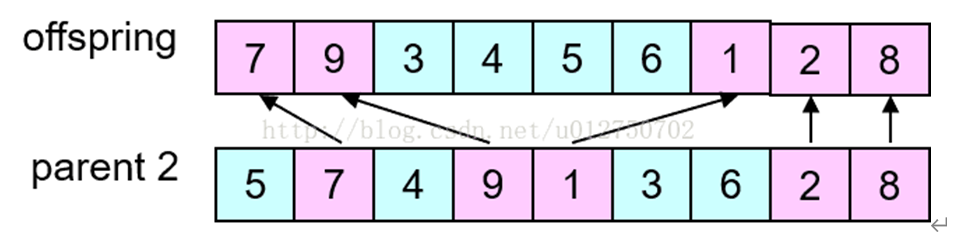
It should be noted that this algorithm will likewise generate two offspring. The generation process for the other offspring is completely the same; you only need to swap the positions of the two parent chromosomes, with the genotype positions selected in step 1 remaining the same. The other offspring in this example is: 254913678
Unlike PMX, there is no need to perform conflict detection (in fact, only PMX needs to do conflict detection).
/// <summary>
/// OX交叉算子
/// </summary>
/// <param name="parent1">父类基因一</param>
/// <param name="parent2">父类基因二</param>
/// <returns>基因片段</returns>
public static List<int[]> OX(int[] parent1, int[] parent2)
{
    List<int[]> ans = new List<int[]>();
    int[] a = new int[parent1.Length], ans1 = new int[parent1.Length], ans2 = new int[parent1.Length];
    int l, m;
    for (int i = 0; i < parent1.Length; i++)
    {
        a[i] = i;
    }

    a = a.OrderBy(c => Guid.NewGuid()).ToArray();
    l = a[0];
    m = a[1];

    if (l < m)
    {
        HashSet<int> set1 = new HashSet<int>(), set2 = new HashSet<int>();
        int j = 0, k = 0;
        for (int i = l; i < m; i++)
        {
            ans2[i] = parent2[i];
            set2.Add(parent2[i]);
            ans1[i] = parent1[i];
            set1.Add(parent1[i]);
        }

        for (int i = 0; i < l; i++)
        {
            while (set1.Contains(parent2[j]))
            {
                j++;
            }

            ans1[i] = parent2[j];
            j++;

            while (set2.Contains(parent1[k]))
            {
                k++;
            }

            ans2[i] = parent1[k];
            k++;
        }

        for (int i = m; i < parent1.Length; i++)
        {
            while (set1.Contains(parent2[j]))
            {
                j++;
            }

            ans1[i] = parent2[j];
            j++;

            while (set2.Contains(parent1[k]))
            {
                k++;
            }

            ans2[i] = parent1[k];
            k++;
        }
    }
    else
    {
        HashSet<int> set1 = new HashSet<int>(), set2 = new HashSet<int>();
        int j = 0, k = 0;
        for (int i = 0; i < m; i++)
        {
            ans2[i] = parent2[i];
            set2.Add(parent2[i]);
            ans1[i] = parent1[i];
            set1.Add(parent1[i]);
        }

        for (int i = l; i < parent1.Length; i++)
        {
            ans2[i] = parent2[i];
            set2.Add(parent2[i]);
            ans1[i] = parent1[i];
            set1.Add(parent1[i]);
        }

        for (int i = m; i < l; i++)
        {
            while (set1.Contains(parent2[j]))
            {
                j++;
            }

            ans1[i] = parent2[j];
            j++;

            while (set2.Contains(parent1[k]))
            {
                k++;
            }

            ans2[i] = parent1[k];
            k++;
        }
    }

    ans.Add(ans1);
    ans.Add(ans2);
    return ans;
}
Position-based Crossover (PBX)
This operator uses discontinuous selection. The specific process is as follows:
Step 1: randomly select several genes in a pair of chromosomes (the parents); the positions need not be continuous, but the selected positions on both chromosomes are the same:

Step 2: same as step 2 of OX, generate an offspring, and ensure that the positions of the selected genes in the offspring are the same as in the parent:

Step 3: also the same as step 3 of OX, first find the positions of the genes selected in step 1 in the other parent, then place the remaining genes in order into the offspring generated in the previous step:
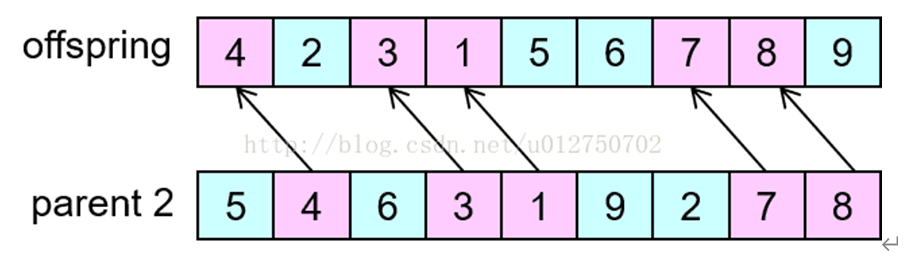
Unlike the previous two algorithms, the selected genotype positions can be discontinuous. Apart from this point, it is basically the same as OX. There are likewise two offspring; the other one in this example is: 243519678.
/// <summary>
/// PBX交叉算子
/// </summary>
/// <param name="parent1">父类基因一</param>
/// <param name="parent2">父类基因二</param>
/// <returns>基因片段</returns>
public static List<int[]> PBX(int[] parent1, int[] parent2)
{
    List<int[]> ans = new List<int[]>();
    int[] a = new int[parent1.Length], ans1 = new int[parent1.Length], ans2 = new int[parent1.Length];
    for (int i = 0; i < parent1.Length; i++)
    {
        a[i] = i;
    }

    a = a.OrderBy(c => Guid.NewGuid()).ToArray();
    int r = rand_int(0, parent1.Length);
    HashSet<int> set = new HashSet<int>(), set1 = new HashSet<int>(), set2 = new HashSet<int>();
    for (int i = 0; i < r; i++)
    {
        set.Add(a[i]);
    }


    foreach (var i in set)
    {
        ans2[i] = parent2[i];
        set2.Add(parent2[i]);
        ans1[i] = parent1[i];
        set1.Add(parent1[i]);
    }

    int j = 0, k = 0;
    for (int i = 0; i < parent1.Length; i++)
    {
        if (set.Contains(i))
        {
            continue;
        }

        while (set1.Contains(parent2[j]))
        {
            j++;
        }

        ans1[i] = parent2[j];
        j++;

        while (set2.Contains(parent1[k]))
        {
            k++;
        }

        ans2[i] = parent1[k];
        k++;
    }

    ans.Add(ans1);
    ans.Add(ans2);
    return ans;
}
Order-Based Crossover (OBX)
This operator uses non-contiguous selection. The specific process is as follows:
Step 1: Randomly select several genes from a pair of chromosomes (parents). The positions need not be contiguous, but the selected positions on both chromosomes are the same:

Step 2 (divided into two sub-steps): First find in parent 2 the positions of the genes selected in parent 1, then use the remaining genes from parent 2 to generate the offspring, ensuring positional correspondence:
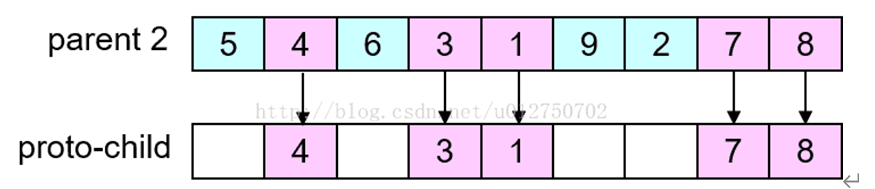
Step 3: Place the selected genes from parent 1 into the remaining positions of the offspring in order:
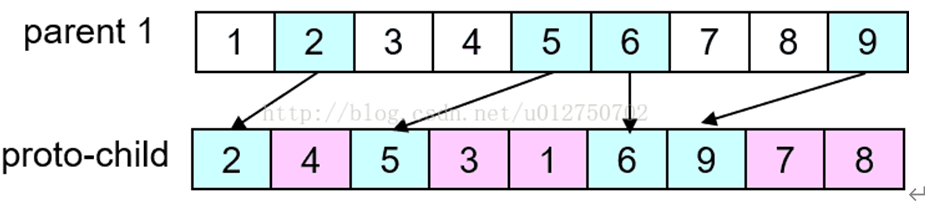
Similarly, swapping parents 1 and 2 yields another offspring (the positions of the selected genes remain unchanged). In this example the result is: 423156798.
Compared with PBX, OBX differs in the source of the “base” genes used to generate offspring: one comes from the selected genes, the other from the remaining ones; otherwise the ideas are essentially similar.
/// <summary>
/// OBX交叉算子
/// </summary>
/// <param name="parent1">父类基因一</param>
/// <param name="parent2">父类基因二</param>
/// <returns>基因片段</returns>
public static List<int[]> OBX(int[] parent1, int[] parent2)
{
    List<int[]> ans = new List<int[]>();
    int[] a = new int[parent1.Length], ans1 = new int[parent1.Length], ans2 = new int[parent1.Length];
    int l, m;
    for (int i = 0; i < parent1.Length; i++)
    {
        a[i] = i;
    }

    a = a.OrderBy(c => Guid.NewGuid()).ToArray();
    int r = rand_int(0, parent1.Length);
    HashSet<int> set1 = new HashSet<int>(), set2 = new HashSet<int>();
    List<int> set = new List<int>();
    for (int i = 0; i < r; i++)
    {
        set.Add(a[i]);
    }


    foreach (var i in set)
    {
        set1.Add(parent1[i]);
        set2.Add(parent2[i]);
    }

    int j = 0, k = 0;
    for (int i = 0; i < parent2.Length; i++)
    {
        if (!set1.Contains(parent2[i]))
        {
            ans1[i] = parent2[i];
        }
        else
        {
            ans1[i] = parent1[set[j]];
            j++;
        }

        if (!set2.Contains(parent1[i]))
        {
            ans2[i] = parent1[i];
        }
        else
        {
            ans2[i] = parent2[set[k]];
            k++;
        }
    }

    ans.Add(ans1);
    ans.Add(ans2);
    return ans;
}
Cycle Crossover (CX)
The specific process of this operator is as follows:
Step 1: Randomly select 1 gene on one parent, then find the gene number at the corresponding position on the other parent, then go back to the first parent to find the position of the gene with the same number, and repeat the previous work until a cycle is formed. The positions of all genes in the cycle are the finally selected positions:
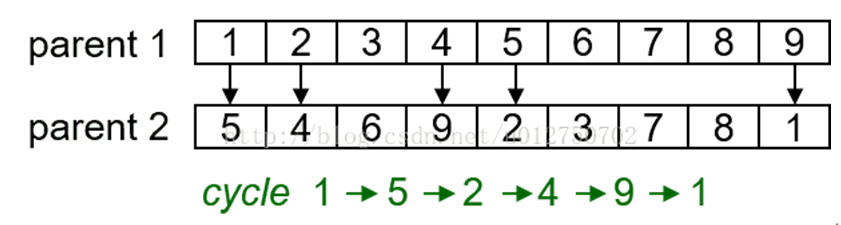
Step 2: Use the selected genes from parent 1 to generate the offspring, ensuring positional correspondence:

Step 3: Place the remaining genes from parent 2 into the offspring:
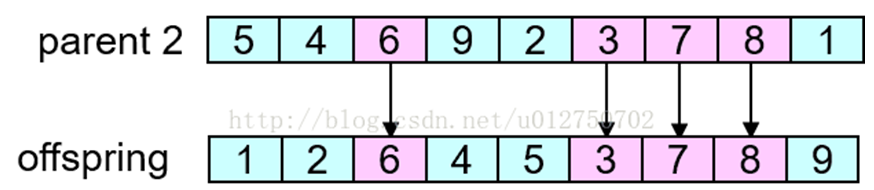
Unlike the algorithms above, only one position needs to be randomly selected on one chromosome. In this example the other offspring is: 543926781.
The process of finding the closed cycle here is actually somewhat similar to conflict detection in PMX; it is just nested loop checks.
/// <summary>
/// CX交叉算子
/// </summary>
/// <param name="parent1">父类基因一</param>
/// <param name="parent2">父类基因二</param>
/// <returns>基因片段</returns>
public static List<int[]> CX(int[] parent1, int[] parent2)
{
    int r = rand_int(0, parent1.Length);
    List<int[]> ans = new List<int[]>();
    int[] ans1 = new int[parent1.Length], ans2 = new int[parent1.Length];
    Dictionary<int, int> dict = new Dictionary<int, int>();
    for (int i = 0; i < parent1.Length; i++)
    {
        dict[parent1[i]] = i;
    }

    Dictionary<int, int> a = new Dictionary<int, int>();
    HashSet<int> set = new HashSet<int>();
    a[parent1[r]] = parent2[r];
    int num = parent2[r];
    ans1[r] = parent1[r];
    ans2[r] = parent2[r];
    set.Add(dict[parent1[r]]);
    while (parent2[dict[num]] != parent1[r])
    {
        a[num] = parent2[dict[num]];
        ans1[dict[num]] = num;
        ans2[dict[num]] = parent2[dict[num]];
        set.Add(dict[num]);
        num = a[num];
    }

    set.Add(dict[num]);
    ans1[dict[num]] = num;
    ans2[dict[num]] = parent2[dict[num]];

    for (int i = 0; i < parent1.Length; i++)
    {
        if (!set.Contains(i))
        {
            ans1[i] = parent2[i];
            ans2[i] = parent1[i];
        }
    }

    ans.Add(ans1);
    ans.Add(ans2);
    return ans;
}
Subtour Exchange Crossover(SEC)
This operator uses contiguous selection. The specific process is as follows:
Step 1: Select a group of genes on one parent, and find the positions of these genes on the other parent:

Step 2: Keep the unselected genes unchanged, and according to the order of appearance of the selected genes, swap the gene positions on the two parent chromosomes, generating two offspring at once:

Unlike the algorithms above, gene positions are selected on only one chromosome.
/// <summary>
/// SEC交叉算子
/// </summary>
/// <param name="parent1">父类基因一</param>
/// <param name="parent2">父类基因二</param>
/// <returns>基因片段</returns>
public static List<int[]> SEC(int[] parent1, int[] parent2)
{
    List<int[]> ans = new List<int[]>();
    int[] a = new int[parent1.Length], ans1 = new int[parent1.Length], ans2 = new int[parent1.Length];
    int l, m, t;
    for (int i = 0; i < parent1.Length; i++)
    {
        a[i] = i;
        ans1[i] = parent1[i];
        ans2[i] = parent2[i];
    }

    a = a.OrderBy(c => Guid.NewGuid()).ToArray();
    l = a[0];
    m = a[1];


    Dictionary<int, int> dict = new Dictionary<int, int>();
    for (int i = 0; i < parent1.Length; i++)
    {
        dict[parent2[i]] = i;
    }

    List<int> index = new List<int>();

    if (l < m)
    {
        for (int i = l; i < m; i++)
        {
            index.Add(dict[parent1[i]]);
        }

        index.Sort();

        for (int i = 0; i < m - l; i++)
        {
            t = ans1[l + i];
            ans1[l + i] = ans2[index[i]];
            ans2[index[i]] = t;
        }
    }
    else
    {
        for (int i = 0; i < m; i++)
        {
            index.Add(dict[parent1[i]]);
        }

        for (int i = l; i < parent1.Length; i++)
        {
            index.Add(dict[parent1[i]]);
        }

        index.Sort();

        for (int i = 0; i < m; i++)
        {
            t = ans1[i];
            ans1[i] = ans2[index[i]];
            ans2[index[i]] = t;
        }

        for (int i = 0; i < parent1.Length - l; i++)
        {
            t = ans1[l + i];
            ans1[l + i] = ans2[index[m + i]];
            ans2[index[m + i]] = t;
        }
    }

    ans.Add(ans1);
    ans.Add(ans2);
    return ans;
}
Other Crossover Operators
The algorithms above all handle genes of int-array type. For genes of bool-array type, processing is much simpler: just select gene segments and swap them. By the same principle, the selection can be either contiguous or non-contiguous.
/// <summary>
/// OX交叉算子
/// </summary>
/// <param name="parent1">父类基因一</param>
/// <param name="parent2">父类基因二</param>
/// <returns>基因片段</returns>
public static List<bool[]> OX(bool[] parent1, bool[] parent2)
{
    List<bool[]> ans = new List<bool[]>();
    int[] a = new int[parent1.Length];
    bool[] ans1 = new bool[parent1.Length], ans2 = new bool[parent2.Length];
    int l, m;
    for (int i = 0; i < parent1.Length; i++)
    {
        a[i] = i;
    }

    a = a.OrderBy(c => Guid.NewGuid()).ToArray();
    l = a[0];
    m = a[1];

    if (l < m)
    {
        for (int i = l; i < m; i++)
        {
            ans1[i] = parent2[i];
            ans2[i] = parent1[i];
        }

        for (int i = 0; i < l; i++)
        {
            ans1[i] = parent1[i];
            ans2[i] = parent2[i];
        }

        for (int i = m; i < parent1.Length; i++)
        {
            ans1[i] = parent1[i];
            ans2[i] = parent2[i];
        }
    }
    else
    {
        for (int i = 0; i < m; i++)
        {
            ans1[i] = parent2[i];
            ans2[i] = parent1[i];
        }

        for (int i = l; i < parent1.Length; i++)
        {
            ans1[i] = parent2[i];
            ans2[i] = parent1[i];
        }

        for (int i = m; i < l; i++)
        {
            ans1[i] = parent1[i];
            ans2[i] = parent2[i];
        }
    }

    ans.Add(ans1);
    ans.Add(ans2);
    return ans;
}

/// <summary>
/// PBX交叉算子
/// </summary>
/// <param name="parent1">父类基因一</param>
/// <param name="parent2">父类基因二</param>
/// <returns>基因片段</returns>
public static List<bool[]> PBX(bool[] parent1, bool[] parent2)
{
    List<bool[]> ans = new List<bool[]>();
    int[] a = new int[parent1.Length];
    bool[] ans1 = new bool[parent1.Length], ans2 = new bool[parent2.Length];
    for (int i = 0; i < parent1.Length; i++)
    {
        a[i] = i;
    }

    a = a.OrderBy(c => Guid.NewGuid()).ToArray();
    int r = rand_int(0, parent1.Length);
    HashSet<int> set = new HashSet<int>(), set1 = new HashSet<int>(), set2 = new HashSet<int>();
    for (int i = 0; i < r; i++)
    {
        set.Add(a[i]);
    }

    for (int i = 0; i < parent1.Length; i++)
    {
        if (set.Contains(i))
        {
            ans1[i] = parent2[i];
            ans2[i] = parent1[i];
        }
        else
        {
            ans1[i] = parent1[i];
            ans2[i] = parent2[i];
        }
    }

    ans.Add(ans1);
    ans.Add(ans2);
    return ans;
}
Mutation Operators
Mutation is relatively much simpler. For genes of int-array type, you only need to select a gene segment (contiguous or non-contiguous) and rearrange it; for genes of bool-array type, you only need to select a gene segment (contiguous or non-contiguous) and invert it.
/// <summary>
/// OX变异算子
/// </summary>
/// <param name="gene">基因片段</param>
/// <returns>基因片段</returns>
public static int[] Variation_OX(int[] gene)
{
    int[] a = new int[gene.Length], ans = new int[gene.Length];
    int l, m;
    for (int i = 0; i < gene.Length; i++)
    {
        a[i] = i;
    }

    a = a.OrderBy(c => Guid.NewGuid()).ToArray();
    l = a[0];
    m = a[1];

    List<int> b = new List<int>();
    if (l < m)
    {
        for (int i = l; i < m; i++)
        {
            b.Add(gene[i]);
        }

        b = b.OrderBy(c => Guid.NewGuid()).ToList();
        for (int i = 0; i < l; i++)
        {
            ans[i] = gene[i];
        }

        for (int i = 0; i < m - l; i++)
        {
            ans[l + i] = b[i];
        }

        for (int i = m; i < gene.Length; i++)
        {
            ans[i] = gene[i];
        }
    }
    else
    {
        for (int i = 0; i < m; i++)
        {
            b.Add(gene[i]);
        }

        for (int i = l; i < gene.Length; i++)
        {
            b.Add(gene[i]);
        }

        b = b.OrderBy(c => Guid.NewGuid()).ToList();
        for (int i = 0; i < m; i++)
        {
            ans[i] = b[i];
        }

        for (int i = m; i < l; i++)
        {
            ans[i] = gene[i];
        }

        for (int i = 0; i < gene.Length - l; i++)
        {
            ans[i + l] = b[m + i];
        }
    }

    return ans;
}

/// <summary>
/// OX变异算子
/// </summary>
/// <param name="gene">基因片段</param>
/// <returns>基因片段</returns>
public static bool[] Variation_OX(bool[] gene)
{
    int[] a = new int[gene.Length];
    int l, m;
    bool[] ans = new bool[gene.Length];
    for (int i = 0; i < gene.Length; i++)
    {
        a[i] = i;
        ans[i] = gene[i];
    }

    a = a.OrderBy(c => Guid.NewGuid()).ToArray();
    l = a[0];
    m = a[1];

    if (l < m)
    {
        for (int i = l; i < m; i++)
        {
            ans[i] = !ans[i];
        }
    }
    else
    {
        for (int i = 0; i < m; i++)
        {
            ans[i] = !ans[i];
        }

        for (int i = l; i < gene.Length; i++)
        {
            ans[i] = !ans[i];
        }
    }

    return ans;
}

/// <summary>
/// PBX变异算子
/// </summary>
/// <param name="gene">基因片段</param>
/// <returns>基因片段</returns>
public static int[] Variation_PBX(int[] gene)
{
    int[] a = new int[gene.Length], ans = new int[gene.Length];
    for (int i = 0; i < gene.Length; i++)
    {
        a[i] = i;
    }

    a = a.OrderBy(c => Guid.NewGuid()).ToArray();
    int r = rand_int(0, gene.Length);
    HashSet<int> set = new HashSet<int>();
    for (int i = 0; i < r; i++)
    {
        set.Add(a[i]);
    }

    List<int> b = new List<int>();
    for (int i = 0; i < gene.Length; i++)
    {
        if (set.Contains(i))
        {
            b.Add(gene[i]);
        }
    }

    b = b.OrderBy(c => Guid.NewGuid()).ToList();
    int num = 0;
    for (int i = 0; i < gene.Length; i++)
    {
        if (set.Contains(i))
        {
            ans[i] = b[num];
            num++;
        }
        else
        {
            ans[i] = gene[i];
        }
    }

    return ans;
}

/// <summary>
/// PBX变异算子
/// </summary>
/// <param name="gene">基因片段</param>
/// <returns>基因片段</returns>
public static bool[] Variation_PBX(bool[] gene)
{
    int[] a = new int[gene.Length];
    bool[] ans = new bool[gene.Length];
    for (int i = 0; i < gene.Length; i++)
    {
        a[i] = i;
    }

    a = a.OrderBy(c => Guid.NewGuid()).ToArray();
    int r = rand_int(0, gene.Length);
    HashSet<int> set = new HashSet<int>();
    for (int i = 0; i < r; i++)
    {
        set.Add(a[i]);
    }

    for (int i = 0; i < gene.Length; i++)
    {
        if (set.Contains(i))
        {
            ans[i] = !gene[i];
        }
        else
        {
            ans[i] = gene[i];
        }
    }


    return ans;
}
That's all for the population class code! Next up is the brief yet core genetic algorithm!
_EOF_
Two-Dimensional Bin Packing Problem with Multiple Constraints — Code Analysis for Finding the Optimal Layout of Cairo Ramen Shop (IV): Crossover Operator Analysis
- 本文作者:
- 程序设计实验室
- 版权声明:
- 本博客所有文章除特别声明外,均采用 BY-NC-SA 许可协议。转载请注明出处!
相关文章
推荐系统开发实践:Surprise库基本用法
首先是构建数据集 这里我使用了随机生成用户和项目,以及用户对项目的评价,喜欢(1)与不喜欢(0) import random import pandas import numpy as np def build_dataframe() - pandas.DataFrame: datasets = { 'userID': [], 'itemID': [],
2021-12-18 · 算法/机器学习 · 约 1 分钟
多个约束条件下的二维装箱问题——寻找《开罗拉面店》最优布局之代码解析(五)遗传算法解析
前言 遗传算法的一些思路我在开篇有提到一些,这里给出具体过程: 1、生成两个种群,分别使用BL算法和BL_plus算法; 2、开始迭代 3、调用两个种群的update_max()函数更新最优个体 4、如果两个种群中有最优解(也就是12家店铺全部铺上去了),则跳出循环,返回该个体; 5、如果达到迭代次数,则跳出循环,返回两个种群的最优个体; 6、如果达到交换迭代次数,则: 假设种群P1的最优个体适应
2021-12-18 · 算法/机器学习 · 约 1 分钟
多个约束条件下的二维装箱问题——寻找《开罗拉面店》最优布局之代码解析(二)
个体类:Individual 属性 一个个体在遗传算法中最关键的属性是基因编码和性状,为此还需要引出一个原始基因的定义(在敲代码的时候我把这玩意儿叫做基因库,但是后来查资料才发现,基因库是用来储存优秀个体,提高种群质量的,和我这里的作用并不相同,所以作出修正)。原始基因就是题目给定的这12个店铺,而在生成个体的基因的时候就只是单纯的在这条原始基因上进行随机重排序操作和随机旋转操作;性状则是进行这两
2021-12-18 · 算法/机器学习 · 约 1 分钟
使用分形思想,通过图灵完备的机器赛跑关卡,并获得小机快跑成就
本文将用尽量通俗易懂的语言, 为了解过和没了解过图灵完备和分形的读者讲解用分形思想来通过机器赛跑这一关并达成成就“小机快跑”的思路, 同时也将给出实现该思路的汇编代码。
2024-02-06 · 算法/机器学习 · 约 1 分钟
讨论
共 0 条加载评论中…