

Two-Dimensional Bin Packing Problem Under Multiple Constraints — Code Analysis for Finding the Optimal Layout of Cairo Ramen Shop (Part 3)
Population class: Population Properties The first thing the population class needs to store is the original genes mentioned in the previous article; second, in order to apply the elite preservation strategy, worst-individual assignment, and so on, it needs to record information related to the best individual; at the same time, when calculating crossover and mutation probabilities, a method for obtaining the average fitness is needed, so to simplify calculation, storing each individual's fitness is quite necessary. /// summary /// Individual list /// /summary public ListIndividual ind; /// summ
目录10 个章节

Population Class: Population
Properties
The first thing the population class needs to store is the original genes mentioned in the previous article; second, in order to apply the elite preservation strategy, worst-individual assignment, and so on, it needs to record information related to the best individual; at the same time, when calculating crossover and mutation probabilities, a method for obtaining the average fitness is needed, so to simplify calculation, storing each individual's fitness is quite necessary.
/// <summary>
/// 个体列表
/// </summary>
public List<Individual> ind;

/// <summary>
/// 原始基因
/// </summary>
private List<Store> gene_pool;

/// <summary>
/// 最优个体
/// </summary>
public Individual Fmax;

/// <summary>
/// 最优个体适应值
/// </summary>
public int fmax;

/// <summary>
/// 最优个体对应索引
/// </summary>
public int fmax_index;

/// <summary>
/// 每个个体的适应值
/// </summary>
public int[] fit_count;
Methods
Update the Best Individual and Update Fitness
In both the elite preservation strategy and the worst-individual assignment strategy, the population's best individual needs to be found, so what needs to be done here is to update the information related to the best individual, and incidentally update the individuals' fitness values.
/// <summary>
/// 更新种群最优个体,并更新适应度
/// </summary>
public void update_max()
{
    int fit;
    for (int i = 0; i < ind.Count; i++)
    {
        fit = ind[i].fit_count();
        fit_count[i] = fit;
        if (fit > fmax)
        {
            fmax_index = i;
            fmax = fit;
            Fmax = ind[i];
        }
    }
}
Crossover Probability
In the paper I mainly referenced (freeloaded), crossover probability is defined as follows:
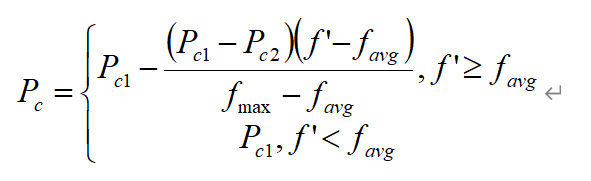
where Pc1=0.9, Pc2=0.6, f' is the larger fitness of the two individuals participating in crossover, favg is the population's average fitness, and fmax is the population's maximum fitness.
To get the average fitness, we have to write a small method to compute it; other than that, it's just plugging into the formula.
/// <summary>
/// 计算种群平均适应度
/// </summary>
/// <returns>平均适应值</returns>
public float avg()
{
    float ans = 0;
    foreach (var i in ind)
    {
        ans += i.fit_count();
    }

    return ans / ind.Count;
}

/// <summary>
/// 计算交叉概率
/// </summary>
/// <param name="ind1">个体一</param>
/// <param name="ind2">个体二</param>
/// <param name="Pc1">参数一</param>
/// <param name="Pc2">参数二</param>
/// <returns>交叉概率</returns>
public double cros_probability(Individual ind1, Individual ind2, double Pc1 = 0.9, double Pc2 = 0.6)
{
    int fit1 = ind1.fit_count(), fit2 = ind2.fit_count(), f;
    float fit_avg = avg();
    update_max();
    if (fit1 > fit2)
    {
        f = fit1;
    }
    else
    {
        f = fit2;
    }

    double ans = Pc1;
    if (f >= fit_avg)
    {
        ans -= (Pc1 - Pc2) * (f - fit_avg) / (fmax - fit_avg);
    }

    return ans;
}
Mutation Probability
Mutation probability is defined as follows:
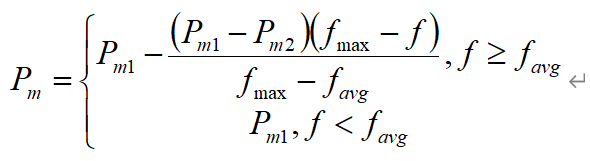
where Pm1=0.1, Pm2=0.01, and f is the fitness of the individual undergoing mutation.
/// <summary>
/// 变异概率
/// </summary>
/// <param name="ind1">个体</param>
/// <param name="Pm1">参数一</param>
/// <param name="Pm2">参数二</param>
/// <returns>变异概率</returns>
public double mut_probability(Individual ind1, double Pm1 = 0.1, double Pm2 = 0.01)
{
    int f = ind1.fit_count();
    float fit_avg = avg();
    update_max();

    double ans = Pm1;
    if (f >= fit_avg)
    {
        ans -= (Pm1 - Pm2) * (fmax - f) / (fmax - fit_avg);
    }

    return ans;
}
Generating Random Numbers
In the crossover operator and mutation operator, generating a random integer is used extensively; in the roulette-wheel algorithm as well as the genetic algorithm, a random real number also needs to be generated.
/// <summary>
/// 生成随机整数
/// </summary>
/// <param name="a">下限</param>
/// <param name="b">上限</param>
/// <returns>随机整数</returns>
public static int rand_int(int a, int b)
{
    byte[] buffer = Guid.NewGuid().ToByteArray();
    int iSeed = BitConverter.ToInt32(buffer, 0);
    Random ran = new Random(iSeed);
    return ran.Next(a, b);
}

/// <summary>
/// 生成(0,1)上的随机实数
/// </summary>
/// <returns>随机实数</returns>
public static double rand_double()
{
    byte[] buffer = Guid.NewGuid().ToByteArray();
    int iSeed = BitConverter.ToInt32(buffer, 0);
    Random ran = new Random(iSeed);
    return ran.NextDouble();
}
Find the Worst Individual in the Population
The worst-individual assignment strategy needs to find the worst individual in the population.
/// <summary>
/// 找出最差个体对应索引
/// </summary>
/// <returns>最差个体对应索引</returns>
public int find_min_index()
{
    int index = 0, fmin = int.MaxValue;
    for (int i = 0; i < ind.Count; i++)
    {
        if (fit_count[i] < fmin)
        {
            index = i;
            fmin = fit_count[i];
        }
    }

    return index;
}
Decoder
As mentioned earlier, the decoder is the method that restores gene encodings back into genes. Because random ordering operations and random rotation operations are performed based on this population's original genes, and there is no need to change the original genes themselves, it needs to call the Store class's clone to perform a deep copy, so as to keep the original genes "pure".
/// <summary>
/// 解码器,由两个基因片段编码生成个体的基因
/// </summary>
/// <param name="gene_order">基因片段编码一</param>
/// <param name="gene_rotate">基因片段编码二</param>
/// <returns>基因</returns>
public List<Store> decode(int[] gene_order, bool[] gene_rotate)
{
    List<Store> ans = new List<Store>();
    gene_pool.ForEach(i => ans.Add(i.Clone()));

    for (int i = 0; i < gene_rotate.Length; i++)
    {
        if (gene_rotate[i])
        {
            ans[i].rotate();
        }
    }

    return ans.OrderBy(e =>
    {
        var index = 0;
        index = Array.IndexOf(gene_order, e.id);
        if (index != -1)
        {
            return index;
        }

        return int.MaxValue;
    }).ToList();
}
Roulette Wheel
The roulette-wheel algorithm is implemented as follows: normalize each individual's fitness (that is, divide by the sum of the population's fitness values), then generate a random number, and see which interval this random number falls into to select that individual. For example, suppose there are four individuals with fitness values 1, 2, 3, and 4 respectively; after normalization they are 0.1, 0.2, 0.3, 0.4. I generate a random real number r=0.61826 on (0,1), which falls in the interval (0.1+0.2+0.3,0.1+0.2+0.3+0.4), so the fourth individual is selected.
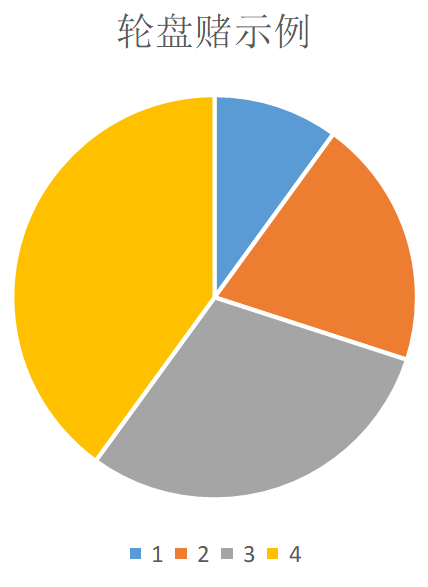
It can be seen quite intuitively that individuals with larger fitness occupy a larger sector area and are thus more likely to be selected. This is precisely the purpose of roulette wheel — survival of the fittest. This helps improve the genetic algorithm's convergence speed, yet due to its randomness, the algorithm is not prone to falling into a local optimum. This is the first manifestation of the unique charm of genetic algorithms.
One more point to note: to guarantee the "purity" of the best individual and try not to disrupt the structure of the best individual, the best individual does not participate in the roulette wheel.
/// <summary>
/// 轮盘赌算法,随机选择个体
/// </summary>
/// <returns>随机选择的个体</returns>
public int roulette()
{
    Dictionary<int, double> dict = new Dictionary<int, double>();
    for (int i = 0; i < ind.Count; i++)
    {
        if (i != fmax_index)
        {
            dict[i] = (double) fit_count[i] / (fit_count.Sum()-fmax);
        }
    }


    double r = rand_double(), sum = 0.0;
    int index = 0;
    foreach (var k in dict)
    {
        sum += k.Value;
        if (sum > r)
        {
            index = k.Key;
            break;
        }
    }

    return index;
}
_EOF_
Two-Dimensional Bin Packing Problem Under Multiple Constraints — Code Analysis for Finding the Optimal Layout of Cairo Ramen Shop (Part 3)
- 本文作者:
- 程序设计实验室
- 版权声明:
- 本博客所有文章除特别声明外,均采用 BY-NC-SA 许可协议。转载请注明出处!
相关文章
推荐系统开发实践:Surprise库基本用法
首先是构建数据集 这里我使用了随机生成用户和项目,以及用户对项目的评价,喜欢(1)与不喜欢(0) import random import pandas import numpy as np def build_dataframe() - pandas.DataFrame: datasets = { 'userID': [], 'itemID': [],
2021-12-18 · 算法/机器学习 · 约 1 分钟
使用分形思想,通过图灵完备的机器赛跑关卡,并获得小机快跑成就
本文将用尽量通俗易懂的语言, 为了解过和没了解过图灵完备和分形的读者讲解用分形思想来通过机器赛跑这一关并达成成就“小机快跑”的思路, 同时也将给出实现该思路的汇编代码。
2024-02-06 · 算法/机器学习 · 约 1 分钟
多个约束条件下的二维装箱问题——寻找《开罗拉面店》最优布局之代码解析(二)
个体类:Individual 属性 一个个体在遗传算法中最关键的属性是基因编码和性状,为此还需要引出一个原始基因的定义(在敲代码的时候我把这玩意儿叫做基因库,但是后来查资料才发现,基因库是用来储存优秀个体,提高种群质量的,和我这里的作用并不相同,所以作出修正)。原始基因就是题目给定的这12个店铺,而在生成个体的基因的时候就只是单纯的在这条原始基因上进行随机重排序操作和随机旋转操作;性状则是进行这两
2021-12-18 · 算法/机器学习 · 约 1 分钟
多个约束条件下的二维装箱问题——寻找《开罗拉面店》最优布局之代码解析(四)交叉算子解析
交叉算子 在常见的交叉算子中,经常会有选取基因片段的操作,有的是连续选取,有的是不连续选取,对于连续选取的交叉算子,我使用的都是环形选择,具体操作是这样的:首先给定起点l和终点m,以及基因长度L,如果l<m,则选取l到m这段基因;如果l>m,则选取0到m和l到L这两段基因,这样可以保证每一“碱基对”被选到的概率是相等的。 交叉算子这里我主要参考的是: https://blog.csdn.net/u
2021-12-18 · 算法/机器学习 · 约 1 分钟
讨论
共 0 条加载评论中…