

The Two-Dimensional Bin Packing Problem Under Multiple Constraints — Code Analysis for Finding the Optimal Layout of Kairo Ramen Shop (Part 2)
Individual Class: Individual Properties The most critical attributes of an individual in a genetic algorithm are the gene encoding and the phenotype. For this, we also need to introduce a definition of the original gene (when I was writing the code I called this thing a gene pool, but later when I looked it up I found that a gene pool is used to store elite individuals and improve population quality, which is not the same as the role it plays here, so I made a correction). The original gene is the 12 shops given in the problem, and when generating an individual's genes we simply perform a random reordering operation and a random rotation operation on this original gene; the phenotype is obtained by performing these two
目录6 个章节

Individual Class: Individual
Properties
The most critical attributes of an individual in a genetic algorithm are the gene encoding and the phenotype. For this, we also need to introduce a definition of the original gene (when I was writing the code I called this thing a gene pool, but later when I looked it up I found that a gene pool is used to store elite individuals and improve population quality, which is not the same as the role it plays here, so I made a correction). The original gene is the 12 shops given in the problem, and when generating an individual's genes we simply perform a random reordering operation and a random rotation operation on this original gene; the phenotype is a feasible solution obtained by taking the gene after these two operations and running it through the BL algorithm or the enhanced BL algorithm, that is, a shop layout. Therefore, the attributes the Individual class should store are the phenotype, the encoding of the gene segments, and the width and height of the region.
/// <summary>
/// 性状
/// </summary>
public List<Store> character;

/// <summary>
/// 地区宽度
/// </summary>
public int Width;

/// <summary>
/// 地区高度
/// </summary>
public int Height;
/// <summary>
/// 基因片段一
/// </summary>
public int[] gene_order;

/// <summary>
/// 基因片段二
/// </summary>
public bool[] gene_rotate;
Methods
Checking Whether the Current Solution Is Feasible
This part mainly addresses constraints 2, 3, and 4, that is, checking whether there is overlap, whether anything is out of bounds, and whether every entrance has a path. The first two are not hard to implement. For constraint 4, the method I used is as follows: first use a 2D bool array to record whether the current cell is walkable. This array is first initialized so that everything is walkable, then I change the area covered by every shop in the current solution to unwalkable, that is, "walls." This is somewhat like walking a maze; what you need to do is determine whether you can walk out of the maze. I use a stack to store the coordinates of the cells that currently need to be searched. Starting from this shop's entrance, I push this entrance onto the stack, then start looping. Each iteration first pops the top of the stack; if the popped cell is not walkable, do nothing; if it is walkable, push the coordinates of the cells in all four directions—up, down, left, and right—onto the stack, until the cell I pop is on the boundary or there are no cells left in the stack, at which point I break out of the loop. Note that the logic here is as follows: as long as there exists a path that can reach the region boundary, this shop is feasible; as long as any one shop is infeasible, the solution is infeasible.
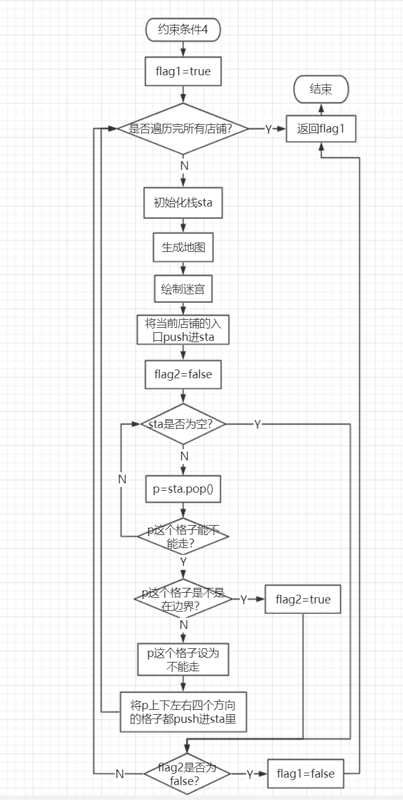
/// <summary>
/// 判断店铺之间是否有重叠
/// </summary>
/// <param name="data">店铺数据</param>
/// <returns>有重叠返回false,没有返回true</returns>
static bool if_end_overlap(List<Store> data)
{
    int i = data.Count - 1;
    for (int j = 0; j < i; j++)
    {
        if (!data[i].overlap_pro(data[j]))
        {
            return false;
        }
    }

    return true;
}

/// <summary>
/// 判断布局是否为可行解
/// </summary>
/// <param name="data">布局数据</param>
/// <returns>可行解返回true,不可行返回false</returns>
public bool is_feasible(List<Store> data)
{
    for (int i = 0; i < data.Count; i++)
    {
        if (data[i].point.X < 0 || data[i].point.Y < 0)
        {
            return false;
        }
    }

    if (!if_end_overlap(data))
    {
        return false;
    }

    bool flag1 = true;
    int[,] direction = new int[4, 2] {{1, 0}, {0, 1}, {-1, 0}, {0, -1}};
    Point p;
    for (int i = 0; i < data.Count; i++)
    {
        Stack<Point> sta = new Stack<Point>();
        bool flag2 = false;
        bool[,] area = area_initialize(data);
        sta.Push(new Point(data[i].door.X + data[i].point.X, data[i].door.Y + data[i].point.Y));
        while (sta.Count > 0)
        {
            p = sta.Pop();
            if (area[p.X, p.Y])
            {
                if (p.X == 0 || p.X == Width - 1 || p.Y == 0 || p.Y == Height - 1)
                {
                    flag2 = true;
                    break;
                }

                area[p.X, p.Y] = false;
                for (int j = 0; j < 4; j++)
                {
                    sta.Push(new Point(p.X + direction[j, 0], p.Y + direction[j, 1]));
                }
            }
        }

        if (!flag2)
        {
            flag1 = false;
            break;
        }
    }

    return flag1;
}

/// <summary>
/// 生成布局的布尔类型二维数组
/// </summary>
/// <param name="data">布局数据</param>
/// <returns>生成的数组</returns>
public bool[,] area_initialize(List<Store> data)
{
    bool[,] area = new bool[Width, Height];
    for (int i = 0; i < Width; i++)
    {
        for (int j = 0; j < Height; j++)
        {
            area[i, j] = true;
        }
    }

    for (int i = 0; i < data.Count; i++)
    {
        for (int j = data[i].point.X; j < data[i].point.X + data[i].width; j++)
        {
            for (int k = data[i].point.Y; k < data[i].point.Y + data[i].height; k++)
            {
                area[j, k] = false;
            }
        }
    }

    return area;
}
The BL Algorithm and the Enhanced BL Algorithm
The ideas and so on for this part have already been pretty much covered earlier, so I'll just show the code here.
/// <summary>
/// BL算法
/// </summary>
/// <param name="data">拉面店数据</param>
/// <returns>铺好的拉面店</returns>
public List<Store> BL(List<Store> data)
{
    List<Store> ans = new List<Store>(), data1 = new List<Store>();
    data.ForEach(i => data1.Add(i.Clone()));
    bool flag1, flag2, flag3, flag = true;
    for (int box = 0; box < data1.Count; box++)
    {
        if (data1[box].set(Width, Height, ans))
        {
            while (true)
            {
                int move_down = data1[box].go_down(ans);
                int move_left = data1[box].go_left(ans);
                if (move_down == 0 && move_left == 0)
                {
                    break;
                }
            }

            ans.Add(data1[box]);
            while (true)
            {
                flag1 = if_go_a_down(ans);
                flag2 = if_go_a_left(ans);
                flag3 = if_go_down_and_left(ans);
                if (!flag1 && !flag2)
                {
                    break;
                }

                if (flag1 && !flag2 && !flag3)
                {
                    ans[ans.Count - 1].point.Y -= 1;
                }

                if (!flag1 && flag2 && !flag3)
                {
                    ans[ans.Count - 1].point.X -= 1;
                }

                if (flag3)
                {
                    ans[ans.Count - 1].point.X -= 1;
                    ans[ans.Count - 1].point.Y -= 1;
                }

                if (flag1 && flag2 && !flag3)
                {
                    ans[ans.Count - 1].point.Y -= 1;
                }
            }
        }
    }

    return ans;
}

/// <summary>
/// 判断是否能下移一格
/// </summary>
/// <param name="data">已填充的店铺数据</param>
/// <returns>能下移返回true,不能返回false</returns>
public bool if_go_a_down(List<Store> data)
{
    List<Store> data1 = new List<Store>();
    data.ForEach(j => data1.Add(j.Clone()));
    int i = data1.Count - 1;
    data1[i].point.Y -= 1;
    return is_feasible(data1);
}

/// <summary>
/// 判断是否能左移一格
/// </summary>
/// <param name="data">已填充的店铺数据</param>
/// <returns>能左移返回true,不能返回false</returns>
public bool if_go_a_left(List<Store> data)
{
    List<Store> data1 = new List<Store>();
    data.ForEach(j => data1.Add(j.Clone()));
    int i = data.Count - 1;
    data1[i].point.X -= 1;
    return is_feasible(data1);
}

/// <summary>
/// 判断是否能同时下移和左移
/// </summary>
/// <param name="data">已填充的店铺数据</param>
/// <returns>能的话返回true,不能返回false</returns>
public bool if_go_down_and_left(List<Store> data)
{
    List<Store> data1 = new List<Store>();
    data.ForEach(j => data1.Add(j.Clone()));
    int i = data1.Count - 1;
    data1[i].point.X -= 1;
    data1[i].point.Y -= 1;
    return is_feasible(data1);
}

/// <summary>
/// BL算法加强版
/// </summary>
/// <param name="data">拉面店数据</param>
/// <returns>铺好的拉面店</returns>
public List<Store> BL_plus(List<Store> data)
{
    List<Store> data1 = new List<Store>();
    data.ForEach(j => data1.Add(j.Clone()));
    List<Store> ans = new List<Store>();
    bool flag1, flag2, flag3;
    for (int box = 0; box < data1.Count; box++)
    {
        if (data1[box].set(Width, Height, ans))
        {
            while (true)
            {
                Point p = data1[box].BL_plus_move(ans);
                if (p.X == 0 && p.Y == 0)
                {
                    break;
                }
            }

            ans.Add(data1[box]);
            while (true)
            {
                flag1 = if_go_a_down(ans);
                flag2 = if_go_a_left(ans);
                flag3 = if_go_down_and_left(ans);
                if (!flag1 && !flag2)
                {
                    break;
                }

                if (flag1 && !flag2 && !flag3)
                {
                    ans[ans.Count - 1].point.Y -= 1;
                }

                if (!flag1 && flag2 && !flag3)
                {
                    ans[ans.Count - 1].point.X -= 1;
                }

                if (flag3)
                {
                    ans[ans.Count - 1].point.X -= 1;
                    ans[ans.Count - 1].point.Y -= 1;
                }

                if (flag1 && flag2 && !flag3)
                {
                    ans[ans.Count - 1].point.Y -= 1;
                }
            }
        }
    }

    return ans;
}
Calculating Individual Fitness
The fitness of an individual is the sum of the areas of all shops in the trait. It is very simple, but also very important.
/// <summary>
/// 计算本个体的适应度
/// </summary>
/// <returns>适应度</returns>
public int fit_count()
{
    int sum = 0;
    for (int i = 0; i < character.Count; i++)
    {
        sum += character[i].width * character[i].height;
    }

    return sum;
}
The above is the implementation of the individual class; next comes the slightly more complex population class.
_EOF_
The Two-Dimensional Bin Packing Problem Under Multiple Constraints — Code Analysis for Finding the Optimal Layout of Kairo Ramen Shop (Part 2)
- 本文作者:
- 程序设计实验室
- 版权声明:
- 本博客所有文章除特别声明外,均采用 BY-NC-SA 许可协议。转载请注明出处!
相关文章
多个约束条件下的二维装箱问题——寻找《开罗拉面店》最优布局之代码解析(五)遗传算法解析
前言 遗传算法的一些思路我在开篇有提到一些,这里给出具体过程: 1、生成两个种群,分别使用BL算法和BL_plus算法; 2、开始迭代 3、调用两个种群的update_max()函数更新最优个体 4、如果两个种群中有最优解(也就是12家店铺全部铺上去了),则跳出循环,返回该个体; 5、如果达到迭代次数,则跳出循环,返回两个种群的最优个体; 6、如果达到交换迭代次数,则: 假设种群P1的最优个体适应
2021-12-18 · 算法/机器学习 · 约 1 分钟
多个约束条件下的二维装箱问题——寻找《开罗拉面店》最优布局之代码解析(四)交叉算子解析
交叉算子 在常见的交叉算子中,经常会有选取基因片段的操作,有的是连续选取,有的是不连续选取,对于连续选取的交叉算子,我使用的都是环形选择,具体操作是这样的:首先给定起点l和终点m,以及基因长度L,如果l<m,则选取l到m这段基因;如果l>m,则选取0到m和l到L这两段基因,这样可以保证每一“碱基对”被选到的概率是相等的。 交叉算子这里我主要参考的是: https://blog.csdn.net/u
2021-12-18 · 算法/机器学习 · 约 1 分钟
推荐系统开发实践:Surprise库基本用法
首先是构建数据集 这里我使用了随机生成用户和项目,以及用户对项目的评价,喜欢(1)与不喜欢(0) import random import pandas import numpy as np def build_dataframe() - pandas.DataFrame: datasets = { 'userID': [], 'itemID': [],
2021-12-18 · 算法/机器学习 · 约 1 分钟
多个约束条件下的二维装箱问题——寻找《开罗拉面店》最优布局之代码解析(三)
种群类:Population 属性 种群类首先要储存的便是上一篇中提到的原始基因;其次为了应用精英保存策略、择伏分配等,需要记录最优个体的相关信息;同时在计算交叉变异概率的时候,需要用到求平均适应值的方法,所以为了简化计算,储存每个个体的适应值是很有必要的。 /// summary /// 个体列表 /// /summary public ListIndividual ind; /// summ
2021-12-18 · 算法/机器学习 · 约 1 分钟
讨论
共 0 条加载评论中…