A small but elegant refactoring: Generate truly beautiful word clouds using C# in Avalonia
The process of refactoring the word cloud display feature in StarBlogPublisher. The author compared two popular C# word cloud libraries and ultimately selected the more powerful Sdcb.WordCloud. The article details how to use this library to obtain word frequency data and generate word cloud images, and presents a comparison of the effects before and after refactoring.
目录11 个章节
Preface
Didn't I previously develop StarBlogPublisher (a Markdown article publishing tool designed for StarBlog) using Avalonia?
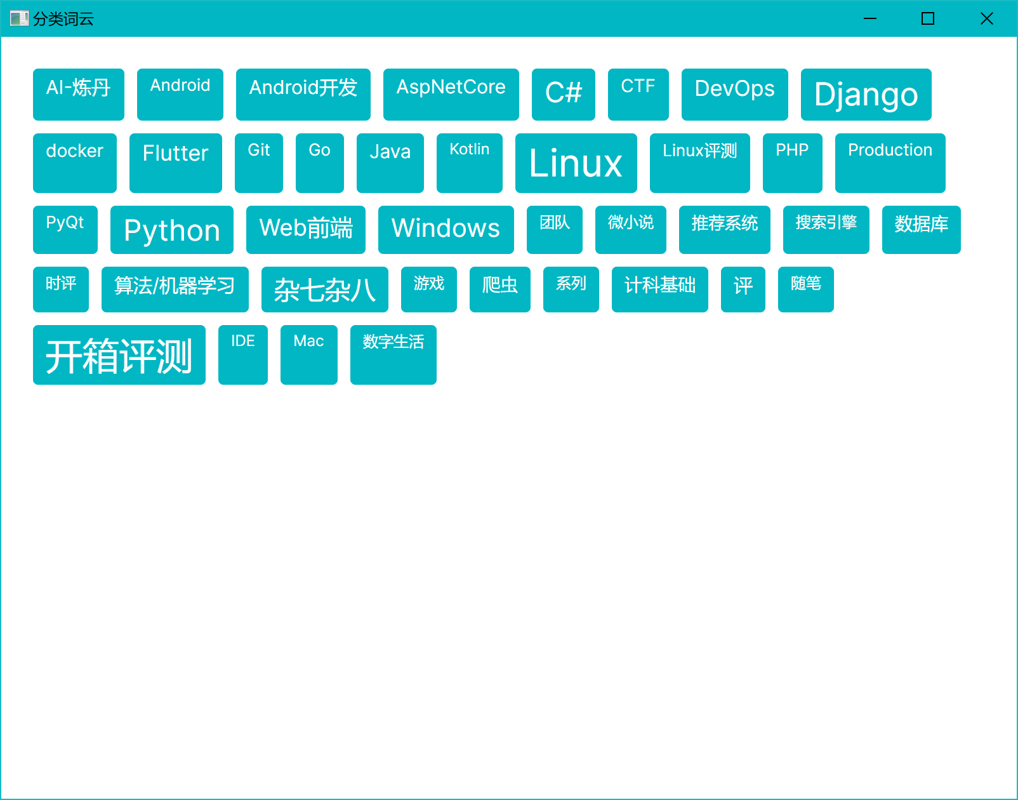
At the time, it included a Word Cloud category display feature. Although the initial version of the word cloud was "usable," the result was extremely crude—essentially just a simple stacking of text, with none of the lively, dense, and staggered aesthetic that a word cloud should have.
Therefore, I decided to completely refactor this module and search anew for a suitable word cloud generation solution.
Selection
Within the Avalonia ecosystem, there is no readily available word cloud component.
However, that's not an issue. The C# ecosystem is relatively rich, offering almost everything you need, and word clouds are certainly no exception.
During my research phase, I found two fairly popular C# word cloud libraries:
Here's a brief comparison:
| Feature | Sdcb.WordCloud | KnowledgePicker.WordCloud |
|---|---|---|
| Rendering Engine | SkiaSharp (cross-platform) | SkiaSharp (cross-platform) |
| Output Format | Image (PNG), SVG, JSON | Image (Bitmap), SVG (requires custom drawing) |
| Customization Level | High (masks, fonts, multi-direction, JSON output, etc.) | Medium (fonts, colors, layout customizable, but no mask support) |
| Mask Functionality | ✅ Natively supports mask images to generate word clouds in specific shapes | ❌ Does not support masks, generates standard rectangular word clouds |
| Recent Maintenance | Actively updated (continuous updates in 2024) | Active (commits in 2024) |
| Usage Complexity | Medium (more configuration, high flexibility) | Medium (simpler, suitable for quick integration) |
Common Points
- Both use
SkiaSharp, which means they can run on Windows, Linux, macOS and other platforms. - Both support flexible configuration of fonts, layouts, and colors, and are very fast.
Key Differences
- Sdcb.WordCloud focuses more on visual effects (supports complex mask patterns), making it suitable for scenarios that pursue custom shapes and cool effects.
- KnowledgePicker.WordCloud prioritizes performance and simplicity, making it ideal for standard rectangular word cloud generation without pursuing complex shapes.
Ultimately, I chose Sdcb.WordCloud for its stronger functionality and better compatibility.
Introduction to Sdcb.WordCloud
Sdcb.WordCloud is a cross-platform word cloud generation library based on SkiaSharp, featuring the following characteristics:
- Cross-platform compatibility: Usable on Windows, Linux, and macOS.
- Multiple output options: Supports generating images, SVG files, or JSON data.
- Highly customizable: Customize fonts, colors, mask patterns, text layout arrangements, and more.
- No dependency on System.Drawing: Easy to deploy in server environments as well.
- Open-source friendly: Licensed under the MIT License, allowing developers to extend it freely.
Installation
dotnet add package Sdcb.WordCloud
Application in StarBlogPublisher: Practical Implementation
The refactored word cloud generation logic primarily consists of two steps:
Get Word Frequency Data
First, request the categorized word frequency data from the backend API and perform a simple expansion (to increase the word cloud density).
private async Task<List<WordScore>?> GetWordScores() {
  var response = await ApiService.Instance.Categories.GetWordCloud();
  if (response.Data == null) throw new Exception("Failed to retrieve word cloud data");

  var originalScores = response.Data
    .Select(e => new WordScore(Score: e.Value, Word: e.Name))
    .ToList();

  var extendedScores = new List<WordScore>();
  foreach (var score in originalScores) {
    for (int i = 0; i < 10; i++) {
      extendedScores.Add(score);
    }
  }

  return extendedScores;
}
A small tip here: 👉 Duplicating the original frequency for each word multiple times can effectively enhance the visual density and richness of the word cloud.
Generating a Word Cloud Image
Once you have the word frequency data, use WordCloud.Create() to create a word cloud object. By customizing it with a mask pattern and font, you can generate the final word cloud image.
private async Task GenerateWordCloudImage() {
  var wordScores = await GetWordScores();
  if (wordScores == null || !wordScores.Any()) {
    ErrorMessage = "No available word cloud data.";
    return;
  }

  var wc = WordCloud.Create(new WordCloudOptions(900, 900, wordScores) {
    FontManager = new FontManager([
      SKTypeface.FromFamilyName("Times New Roman")
    ]),
    Mask = MaskOptions.CreateWithForegroundColor(
      SKBitmap.Decode(await new HttpClient().GetByteArrayAsync(
        "https://io.starworks.cc:88/cv-public/2024/alice_mask.png"
      )),
      SKColors.White
    )
  });

  using var skImage = wc.ToSKBitmap();
  using var data = skImage.Encode(SKEncodedImageFormat.Png, 100);
  using var stream = new MemoryStream(data.ToArray());
  WordCloudImage = new Bitmap(stream);
}
Two simple techniques are used here to enhance the experience:
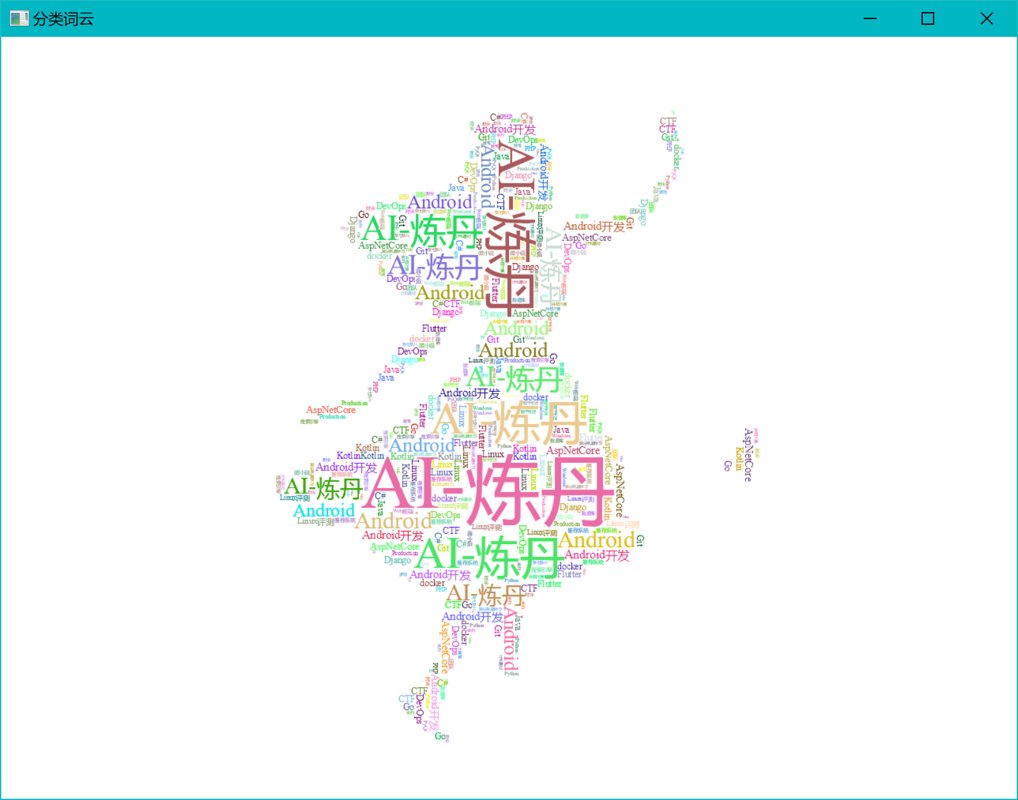
- 📄 Mask Image: By using a transparent image with a specific shape, the word cloud can form silhouettes like people or logos, greatly improving its visual appeal.
- 🖋 Custom Font: Changing the font allows the overall style to better match the design of your website or application.
Effect Demonstration
Could that really count as a word cloud from before??
| Before Modification | After Modification |
|---|---|
 |  |
Summary
Through this refactoring, I've summarized a few key takeaways:
- Choosing the right library is crucial—cross-platform support and high extensibility are the top priorities.
- The aesthetics of a word cloud hinge on the combination of density, mask shape, and font style.
- Prioritize asynchronous requests (异步请求) and local optimization (局部优化) whenever possible to prevent UI lag.
If you also need to integrate word cloud functionality into your C# project, give Sdcb.WordCloud a try—it's simple, efficient, and delivers great results.
_EOF_
A small but elegant refactoring: Generate truly beautiful word clouds using C# in Avalonia
- 本文作者:
- 程序设计实验室
- 版权声明:
- 本博客所有文章除特别声明外,均采用 BY-NC-SA 许可协议。转载请注明出处!
相关文章
开发现代化的.NetCore控制台程序:(2)创建一个C#项目模板
又一个.NetCore模板?FluentConsole.Templates,一键生成骨架,包含DI、日志、配置。安装?dotnet new install,然后dotnet new flu-cli -n MyProject。太简单了吧,谁在乎?
2023-11-10 · C# · 约 1 分钟
C#高性能数组拷贝实验
前言 昨天 wc(Wyu_Cnk) 提了个问题 C# 里多维数组拷贝有没有什么比较优雅的写法? 这不是问对人了吗?正好我最近在搞图像处理,要和内存打交道,我一下就想到了在C#里面直接像C/C++一样做内存拷贝。 优雅?no,要的就是装逼,而且性能还要强🕶 概念 首先澄清一下 C# 里的多维数组 (Multi-dimensional Array) 是这样的 byte[,] arr = new by
2023-01-30 · C# · 约 1 分钟
使用C#和MemoryCache组件实现轮流调用APIKey以提高并发能力
本文介绍了如何利用C#语言中的MemoryCache组件,结合并发编程技巧,实现轮流调用多个API Key以提高系统的并发能力。通过示例代码和详细说明,读者将了解如何有效地管理API Key的调用次数限制,并优化系统性能。
2024-03-09 · C# · 约 1 分钟
C#学习(一)委托的概念和使用
前言 C#学习系列是根据我以前的笔记整理出来复习,顺便发一下文章做个记录。 先引用一个介绍: C# 中的委托(Delegate)类似于 C 或 C++ 中函数的指针。委托(Delegate) 是存有对某个方法的引用的一种引用类型变量。引用可在运行时被改变。 委托(Delegate)特别用于实现事件和回调方法。所有的委托(Delegate)都派生自 System.Delegate 类。 根据使用其他
2021-12-18 · C# · 约 1 分钟
讨论
共 0 条加载评论中…