

Why Are Douyin and Toutiao So Popular? Unveiling Recommendation System Principles: The Collaborative Filtering Algorithm
The previous article briefly introduced the basic principles and classification of recommendation systems. This article focuses on the principles and implementation of collaborative filtering~ Collaborative Filtering Collaborative filtering recommends information that users may be interested in by leveraging the preferences of a group of people with similar interests and shared experiences. Collaborative filtering algorithms make maximum use of the similarity correlations between users or between items, and then make recommendations based on this information. For example, you and one of your friends both like listening to music, and the genres you like are quite similar. Your friend has a high opinion of a certain song
目录12 个章节
The previous article briefly introduced the basic principles and classification of recommendation systems. This article focuses on the principles and implementation of collaborative filtering~
Collaborative Filtering
Collaborative filtering recommends information that users may be interested in by leveraging the preferences of a group of people with similar interests and shared experiences.
Collaborative filtering algorithms make maximum use of the similarity correlations between users or between items, and then make recommendations based on this information. For example, you and one of your friends both like listening to music, and the genres you like are quite similar. Your friend has a high opinion of a certain song that you haven't heard yet. So, couldn't I recommend this song to you?
To implement collaborative filtering, the following 3 steps are needed:
- Collect user preferences
- Find similar users or items
- Compute recommendations
Two common problems that collaborative filtering may encounter due to too small a sample size are:
- Sparsity problem — because users have made too few ratings, the calculated correlation coefficients are inaccurate
- Cold start problem — because items have received too few ratings, they have no “right” to enter the recommendation list
Therefore, when recommending for new users and new items, using some more general methods may work better. For example:
- Recommend more movies with extremely high average scores to new users;
- Recommend new movies to people who like similar movies (e.g., those with the same director or actors).
The latter approach requires maintaining an item classification table, which can be based on item metadata or obtained through clustering.
Classification of Collaborative Filtering
-
User-based recommendation (find similar neighbor users through shared tastes and preferences, K-nearest neighbors algorithm; if your friends like it, you might like it too)
-
Item-based recommendation (discover similarity between items and recommend similar items; if you like item A, and C is similar to A, you might also like C)
-
Model-based recommendation (construct a recommendation model based on sample user preference information, then predict recommendations based on real-time user preference information)
Collecting User Preferences
| User Behavior | Type | Characteristics | Effect |
|---|---|---|---|
| Rating | Explicit | Integer quantified value [0,n] | Can obtain precise preferences |
| Voting | Explicit | Boolean quantified value [0,1] | Can obtain precise preferences |
| Reposting | Explicit | Boolean quantified value [0,1] | Can obtain precise preferences |
| Saving bookmarks | Explicit | Boolean quantified value [0,1] | Can obtain precise preferences |
| Tagging | Explicit | Some words | Needs further analysis to obtain preferences |
| Comments | Explicit | Some text | Needs further analysis to obtain preferences |
| Clickstream | Implicit | A set of click records | Needs further analysis to obtain preferences |
| Page dwell time | Implicit | A set of time information | Relatively noisy, hard to utilize |
| Purchase | Implicit | Boolean quantified value [0,1] | Can obtain precise preferences |
After collecting the raw user preference data, perform preprocessing:
- User behavior identification/combination
In typical applications, we usually extract more than one type of user behavior. Regarding how to combine these different user behaviors, for example, we can divide user behaviors into “view” and “purchase”, etc., and then compute different user / item similarities based on different behaviors.
Similar to Dangdang or JD.com's “People who bought this book also bought …”, “People who viewed this book also viewed …”
- Preference degree weighting
Weight them according to the degree to which different behaviors reflect user preferences, to obtain the user's overall preference for items.
Generally speaking, explicit user feedback has a larger weight than implicit feedback, but it is relatively sparse, since after all only a minority of users provide explicit feedback; at the same time, compared to “view”, “purchase” behavior reflects a greater degree of user preference, but this also varies by application.
- Data denoising and normalization.
- Denoising: User behavior data is generated while users use the application. It may contain a large amount of noise and user misoperations. We can filter out the noise in the behavior data through classic data mining algorithms, which can make our analysis more precise.
- Normalization: As mentioned earlier, when computing the user's degree of preference for items, we may need to weight different behavior data. But as one can imagine, the values of different behavior data may differ greatly. For example, a user's view data is bound to be much larger than purchase data. How to unify the data of each behavior into the same value range, so that the overall preference obtained by weighted summation is more precise, requires us to perform normalization. The simplest normalization is to divide each type of data by the maximum value in that type, to ensure that the normalized data values are in the [0,1] range.
- Forming the user preference matrix
Generally it is a two-dimensional matrix, one dimension is the user list, the other is the item list, and the values are the user's preferences for items, generally floating-point values in [0,1] or [-1, 1].
Finding Similar Users or Items
Finding similar users or items: compute the similarity of users or items, and find similar neighbors.
Similarity Computation
Both User CF and Item CF rely on similarity computation, because only by measuring the similarity between users or between items can we find a user's “neighbors” and complete the recommendation.
Similarity can be measured by computing Euclidean distance, Pearson correlation coefficient, Cosine similarity, and Tanimoto coefficient:
- Euclidean Distance
$$ d(x,y)=\sqrt{(∑(xi−yi)^2))} $$
$$ sim(x,y)=\frac{1}{1+d(x,y)} $$
- Pearson Correlation Coefficient
$$ p(x,y) =\frac{∑x_iy_i−n\overline{x}\overline{y}}{(n−1)S_xS_y} =\frac{n∑x_iy_i−∑x_i∑y_i}{\sqrt{n∑x_i^2−(∑x_i)^2}\sqrt{n∑y_i^2−(∑y_i)^2}} $$
- Cosine Similarity
$$ T(x,y) =\frac{x⋅y}{∥x∥^2×∥y∥^2} =\frac{\sum{x_iy_i}}{\sqrt{\sum{x_i^2}}\sqrt{\sum{y_i^2}}} $$
- Tanimoto Coefficient
$$ T(x,y)=\frac{x⋅y}{∥x∥^2+∥y∥^2−x⋅y} =\frac{\sum{xiyi}}{\sqrt{∑x_i^2}+\sqrt{∑y_i^2}−∑x_iy_i} $$
Similar Neighbor Computation
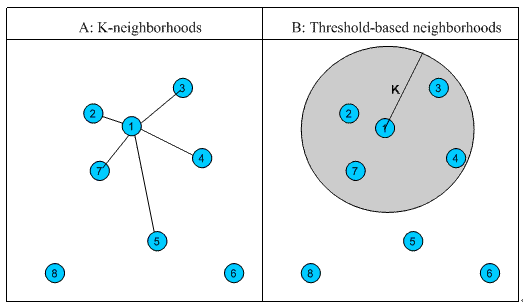
After computing similarity, similar neighbors can be selected through a fixed number of neighbors or threshold-based neighbors.
1. A Fixed Number of K Neighbors
K-neighborhoods: the meaning is quite clear — take the top K in descending order of scores.
Use the “nearest” K users or items as neighbors. As shown in A in the figure below, suppose we want to compute the 5-neighbors of point 1. Then according to the distances between points, we take the nearest 5 points, which are point 2, point 3, point 4, point 7, and point 5. But we can clearly see that this method does not work well for isolated points, because a fixed number of neighbors must be taken. When there are not enough relatively similar points nearby, it is forced to take some not-so-similar points as neighbors, which affects the degree of neighbor similarity. For example, in Figure 1, point 1 and point 5 are actually not very similar.
2. Threshold-Based Neighbors
Threshord-based neighborhood: take those with scores of K or above as neighbors
Unlike the principle of computing a fixed number of neighbors, threshold-based neighbor computation imposes a maximum limit on how far neighbors can be. All points that fall within a region centered on the current point with distance K are taken as neighbors of the current point. The number of neighbors computed by this method is uncertain, but there will not be large errors in similarity. As shown in B in the figure below, starting from point 1, compute neighbors whose similarity is within K, obtaining point 2, point 3, point 4, and point 7. The degree of neighbor similarity computed by this method is better than the previous one, especially in handling isolated points.
What Threshold-based neighborhoods aims to express is “better fewer than shoddy” — the effect is very pronounced when data is sparse.
Based on the different subjects of similarity computation, collaborative filtering recommendation algorithms can be divided into user-based collaborative filtering (UserCF) and item-based collaborative filtering (ItemCF). A comparison of the two is shown in the following table:
| UserCF | ItemCF | |
|---|---|---|
| Performance | Suitable for scenarios with fewer users; if there are too many users, the cost of computing the user similarity matrix increases | Suitable for scenarios where the number of items is significantly smaller than the number of users; if there are many items, the cost of computing the item similarity matrix increases |
| Domain | High requirements for timeliness, low requirements for personalized user interests | Rich long-tail items, strong personalized user needs |
| Real-time | When a user has new behavior, the recommendation results do not necessarily need to change immediately | When a user has new behavior, it will definitely cause real-time changes in recommendation results |
| Cold start | After a new user takes actions on a few items, personalized recommendations cannot be made for them immediately, because user similarity is computed offline; some time after a new item goes live, once users take actions on the item, the new item can be recommended to other users | As long as a new user takes action on one item, related items can be recommended to them, but new items cannot be recommended to users without offline updating of the item similarity table (however, the arrival of a new item is likewise a cold start problem) |
| Recommendation reason | Hard to provide a convincing recommendation explanation to users | Can summarize recommendation reasons based on the user's historical behavior |
Example of user-based collaborative filtering:
| User/Item | Item 1 | Item 2 | Item 3 | Item 4 |
|---|---|---|---|---|
| User A | √ | √ | Recommend | |
| User B | √ | |||
| User C | √ | √ | √ |
User A and User C both like Item 1 and Item 3. The user-based collaborative filtering algorithm considers User A and User C to have similar preferences, so it recommends Item 4, which User C likes, to User A.
Example of item-based collaborative filtering:
| User/Item | Item 1 | Item 2 | Item 3 |
|---|---|---|---|
| User A | √ | √ | |
| User B | √ | √ | √ |
| User C | √ | Recommend |
Item 1 and Item 3 are both liked by User A and User B. The item-based collaborative filtering algorithm considers Item 1 and Item 3 to be of similar types. Because User C likes Item 1, Item 3 is recommended to User C.
Computing Recommendations
Recommendation Based on User Similarity
This is actually the computation process of the KNN algorithm.
For similarity computation, it is best to use the Pearson correlation coefficient and threshold-based neighbors to select similar users.
Recommendation Based on Item Similarity
As shown in the following example:
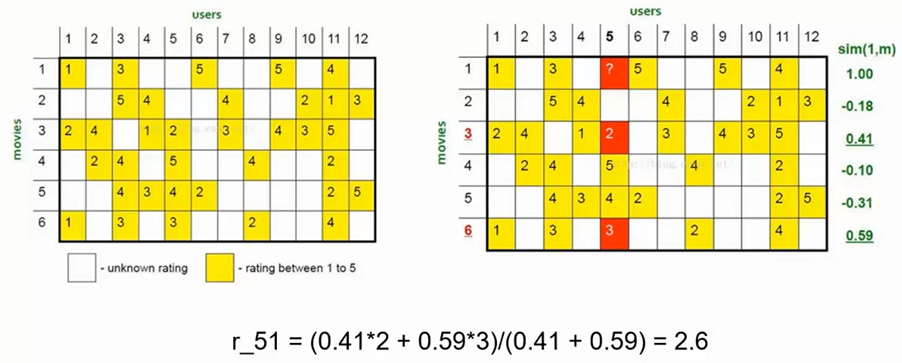
The table above is a user-movie rating table. If I want to predict User 5's rating of Movie 1 in order to make a recommendation decision (recommend only if the rating is greater than 3.5), we can do this:
Separately compute the similarity between Movie 1 and Movie 2, Movie 3, and other movies (preprocess the ratings if necessary to eliminate data differences), denoted as
$$
sim(1,m)
$$
Take two similarities: the largest and the second largest, which are 0.59,0.410.59,0.41 respectively. These are the similar neighbors. Then through weighted computation, User 5's predicted rating for Movie 1 is 2.6, and the recommendation decision is: do not recommend.
That's the basic principle and implementation of the collaborative filtering algorithm. Douyin and Toutiao may not necessarily use collaborative filtering, but this algorithm is essential for getting started with recommendation systems. For basically simple systems, using collaborative filtering is enough.
Welcome to Discuss
I have compiled a series of technical articles and materials. Reply with linux, flutter, c#, netcore, android, java, python, etc. in the backend of the WeChat official account “Programming Lab” to obtain related technical articles and materials. Meanwhile, if you have any questions, you can leave a message in the official account backend~
_EOF_
Why Are Douyin and Toutiao So Popular? Unveiling Recommendation System Principles: The Collaborative Filtering Algorithm
- 本文作者:
- 程序设计实验室
- 版权声明:
- 本博客所有文章除特别声明外,均采用 BY-NC-SA 许可协议。转载请注明出处!
相关文章
知乎和抖音为什么那么让人上瘾?推荐系统工作原理初探
推荐系统简介 推荐系统(Recommender system)是帮助用户发现内容,克服信息过载的重要工具。它通过分析用户行为,对用户兴趣建模,从而预测用户的兴趣并给用户做推荐。 一位研究互联网对社会和经济影响的美国作家Clay Shirky (克莱·舍基)曾说过一句话:“人类面临的问题并非信息泛滥,而是信息过滤失效”。淘宝、亚马逊、网易云音乐、Instagram和各大视频网站等都利用推荐系统给用户
2021-12-18 · 推荐系统 · 约 1 分钟
Java开发:JDK安装和环境配置
前言 环境配置是开发中最基础的部分,不过最近有很多新入坑的同学,都在问怎么安装JDK和配置环境,索性写一篇。 这里要注意一下,在Windows平台和Linux平台下做开发是不同的,Windows平台开发Java需要自己手动配置JDK的环境变量,而大多数Linux都是不需要的,安装了OpenJDK就可以了(可能很多发行版都自带了OpenJDK),这点是比较方便的。 下载Java JDK Window
2023-02-08 · Java · 约 1 分钟
让 C# 也拥有 gofmt 般的体验:用 CSharpier + Roslyn 实现 csfmt
C# 代码长到像答辩?用 CSharpier 自动折行,再用 Roslyn 修正 K&R 花括号,Taskfile 一键收尾。再补上 format-check,省得 CI 反复制造 Git diff。两步流水线并非原生 gofmt,顺序和版本仍得老实锁住。
2026-10-22 · C# · 约 1 分钟
CentOS6安装Nginx,Linux编译安装Nginx
前言 最近笔者把一个django项目部署到一个新的服务器上,而这个服务器给的是CentOS6版本的系统,官方源很旧,yum管理器被运维搞坏了,没办法加载epel源,所以想要用nginx就只能自己编译安装咯~ 下载nginx代码 首先到Nginx的官网下载安装文件。 链接:http://nginx.org/ 我用的版本是:nginx-1.12.1.tar.gz 安装编译所需环境 安装gcc 安装 n
2022-06-17 · Linux · 约 1 分钟
讨论
共 0 条加载评论中…