

Introduction to Buddhism: On the Prajñāpāramitā Heart Sutra~
Introduction The following is excerpted from Wikipedia~ The simplest introduction: The Heart Sutra (Sanskrit: प्रज्ञापारमिताहृदयसूत्र Prajñāpāramitā Hṛdaya sūtra) is a sūtra that expounds the Mahayana Buddhist teachings of emptiness and prajñā. It is also known as the Mahāprajñāpāramitā Heart Sutra Spoken by the Buddha and the Mahāprajñāpāramitā Heart Sutra, abbreviated as the Prajñā Heart Sutra or the Heart Sutra. This sūtra is the teaching of the true nature of all dharmas from the Larger and Smaller Prajñāpāramitā, and is an extremely condensed sūtra of just over two hundred characters distilled from the Mahāprajñāpāramitā Sūtra
目录10 个章节
Introduction
The following is excerpted from Wikipedia~
The simplest introduction:
The Prajñāpāramitā Heart Sutra (Sanskrit: प्रज्ञापारमिताहृदयसूत्र Prajñāpāramitā Hṛdaya sūtra) is a sūtra that expounds the Mahayana Buddhist teachings of emptiness and prajñā. It is also known as the Mahāprajñāpāramitā Heart Sutra Spoken by the Buddha and the Mahāprajñāpāramitā Heart Sutra, abbreviated as the Prajñā Heart Sutra or the Heart Sutra. This sūtra is the teaching of the true nature of all dharmas from the Larger and Smaller Prajñāpāramitā, and is an extremely condensed classic of just over two hundred characters distilled from the Mahāprajñāpāramitā Sūtra. It is therefore an extremely important text in the Prajñāpāramitā sūtra series, and is often considered able to mutually illuminate the Prajñāpāramitā-class Diamond Sutra
Overview:
The Prajñāpāramitā Heart Sutra is a concentrated compilation of the essential points of the Prajñāpāramitā sūtras. Among them:
- “Prajñāpāramitā” (Sanskrit: Prajñāpāramitā) means, through hearing and practicing the words, personally realizing prajñā wisdom, transcending the saṃsāra of birth and death, and reaching the unborn and undying realm of liberation.
- Heart (Sanskrit: Hṛdaya), originally meaning the heart (organ), is different from the mind of consciousness (Pali: Citta); here it means the essence or the marrow. The Japanese scholar Fukui Fumimasa, through textual research, found that “heart” (Sanskrit: Hṛdaya) has the meanings of secret mantra, mantra, and dhāraṇī, and thus can be translated as heart dhāraṇī or heart mantra. Zhi Qian’s translation is titled the Mahāprajñāpāramitā Mantra. In the Sanskrit text it is also called the Prajñāpāramitā Heart Dhāraṇī, and the Tibetan text is called The Essence of Prajñāpāramitā Spoken by the Bhagavatī, none of which call it a sūtra (sūtra). In Mahayana Buddhism, Prajñāpāramitā and its scriptures are the most essential. Therefore the Prajñāpāramitā Heart Sutra, interpreted according to the six types of compound analysis, is a karmadhāraya: “Prajñāpāramitā” is itself the “heart.” Hence, literally, the Mahāprajñāpāramitā Heart Sutra means “great-wisdom-essence-sūtra.”
The structure of the currently popular Xuanzang translation of the Heart Sutra is as follows: by contemplating one’s inner awareness (the Bodhisattva Avalokiteśvara), when the practice of the six perfections is complete (when practicing the profound Prajñāpāramitā), one reaches the state in which the Five Aggregates are all empty, and it explains that all Buddhas of the three times attain Anuttarā-samyak-saṃbodhi through this manner of practice. The Śāriputra mentioned therein is describing that the Five Aggregates are all empty, so the Heart Sutra is not, as another account has it, a dialogue between Avalokiteśvara and Śāriputra; most of its source comes from the Mahāprajñāpāramitā Sūtra Second Assembly, fascicle 403, Contemplation Chapter, part 3.2, i.e., the Larger Prajñāpāramitā, Correspondence Chapter 3). The passage “Prajñāpāramitā is the great divine mantra...” comes from the Mahāprajñāpāramitā Sūtra Second Assembly, Merits Chapter 32, i.e., the Larger Prajñāpāramitā, Exhortation to Uphold Chapter 34. The mantra text comes from the Dhāraṇī Collection Sūtra Spoken by the Buddha, volume 3, Prajñā Great Heart Dhāraṇī no. 16. Thus the Heart Sutra is the essence taken from the Prajñāpāramitā sūtras, with a secret mantra added, completing the organizational form of the Heart Sutra as it exists today.
The Heart Sutra is, among all Buddhist scriptures, the one translated the most times, into the richest variety of languages, and the most frequently read aloud and recited. There are two versions: the longer text and the shorter text. The longer text has a preface section, a main teaching section, and a circulation section. The shorter text has only the main teaching section; both Kumārajīva’s and Xuanzang’s translations are shorter texts. In Chinese Buddhism, the commonly seen version of the Heart Sutra is Xuanzang’s translation, totaling 260 characters. Its language is concise yet rich in meaning, vast and profound, outlining the essentials and directly illuminating the “ultimate truth,” concentrating the essence of Prajñā studies. It is one of the Buddhist scriptures recited daily by both monastic and lay Mahayana Buddhist practitioners. The line “form is emptiness, emptiness is form” comes from this sūtra, clarifying that the Five Skandhas (form, sensation, perception, formation, consciousness) and even the myriad dharmas of the eighteen dhātus, and the empty nature of all dharmas (having no independent, permanent, unchanging self-nature), are in fact the Middle Way of neither the same nor different.
The Heart Sutra text itself
Still, let’s first put up the Sanskrit version, even though none of us can read it~
Sanskrit version
आर्यावलोकितेश्वरो बोधिसत्त्वो गंभीरायां प्रज्ञापारमितायां चर्यां चरमाणो व्यवलोकयति स्म । पंचस्कन्धाः । तांश्च स्वभावशून्यान्पश्यति स्म । इह शारिपुत्र रूपं शून्यता शून्यतैव रूपं रूपान्न पृथक्शून्यता शून्यताया न पृथग्रूपं यद्रूपं सा शून्यता या शून्यता तद्रूपं । एवमेव वेदनासंज्ञासंस्कारविज्ञानानि । इह शारिपुत्र सर्वधर्माः शून्यतालक्षणा अनुत्पन्ना अनिरुद्धा अमला न विमला नोना न परिपूर्णाः । तस्माच्छारिपुत्र शून्यतायां न रूपं न वेदना न संज्ञा न संस्कारा न विज्ञानानि । न चक्षुःश्रोत्रघ्राणजिह्वाकायमनांसी । न रूपशब्दगंधरसस्प्रष्टव्यधर्माः । न चक्षुर्धातुर्यावन्न मनोविज्ञानधातुः । न विद्या नाविद्या न विद्याक्षयो नाविद्याक्षयो यावन्न जरामरणं न जरामरणक्षयो न दुःखसमुदयनिरोधमार्गा न ज्ञानं न प्राप्तिः ॥ तस्मादप्राप्तित्वाद्बोधिसत्त्वाणां प्रज्ञापारमितामाश्रित्य विहरत्यचित्तावरणः । चित्तावरणनास्तित्वादत्रस्तो विपर्यासातिक्रान्तो निष्ठनिर्वाणः ।। त्र्यध्वव्यवस्थिताः सर्वबुद्धाः प्रज्ञापारमितामाश्रित्यानुत्तरां सम्यक्सम्बोधिमभिसंबुद्धाः ।। तस्माज्ज्ञातव्यं प्रज्ञापारमिता महामन्त्रो महाविद्यामन्त्रो ऽनुत्तरमन्त्रो ऽसमसममन्त्रः सर्वदुःखप्रशमनः । सत्यममिथ्यत्वात् । प्रज्ञपारमितायामुक्तो मन्त्रः । तद्यथा गते गते पारगते पारसंगते बोधि स्वाहा ।। इति प्रज्ञापारमिताहृदयं समाप्तम्
Chinese translation
That is, the version circulating among us now~ This version was translated by Master Xuanzang~ (that’s the famous Tang Monk!)
When the Bodhisattva Avalokiteśvara was practicing the profound Prajñāpāramitā.
He clearly saw that the Five Aggregates are all empty, and crossed beyond all suffering and calamity.
Śāriputra, form is not different from emptiness, emptiness is not different from form,
form is emptiness, emptiness is form; sensation, perception, formation, and consciousness are also thus.
Śāriputra, all dharmas are empty of characteristics: not born, not destroyed, not defiled, not pure, not increasing, not decreasing.
Therefore in emptiness there is no form, no sensation, perception, formation, or consciousness,
no eye, ear, nose, tongue, body, or mind; no form, sound, smell, taste, touch, or dharmas; no realm of the eye, and so on up to no realm of mind-consciousness.
There is no ignorance, and also no extinction of ignorance, and so on up to no old age and death, and also no extinction of old age and death.
There is no suffering, origination, cessation, or path; no wisdom and also no attainment.
Because there is nothing to be attained, the bodhisattva,
relying on Prajñāpāramitā, has a mind without obstruction; because there is no obstruction,
there is no fear, far removed from inverted dream-thinking, ultimately nirvana.
All Buddhas of the three times, relying on Prajñāpāramitā, attain Anuttarā-samyak-saṃbodhi.
Therefore know that Prajñāpāramitā is the great divine mantra, the great illuminating mantra, the unsurpassed mantra, the unequaled mantra,
able to remove all suffering, true and not false. Therefore the Prajñāpāramitā mantra is spoken;
namely the mantra is uttered: Gate gate, pāragate, pārasaṃgate, bodhi svāhā.
A few explanations of the text
-
The Heart Sutra text begins with “Avalokiteśvara Bodhisattva” and ends with “bodhi svāhā.” “Guanzizai Bodhisattva”: this should be the name of a bodhisattva. Judging from the Mahāprajñāpāramitā Sūtra, where Constant Diligence Bodhisattva, Great Valor Bodhisattva, Avalokiteśvara Bodhisattva and many great bodhisattvas are listed together, its Sanskrit is [Avalokiteśvara]; “svāhā” is a benedictory phrase, echoing the beginning of the text.
-
“Śāriputra” is Śāriputra, one of the words in the entire Heart Sutra text.
-
There are many interpretations of the Heart Sutra text, including exoteric Buddhist interpretations and esoteric Buddhist interpretations. The exoteric meaning is emptiness; the esoteric meaning is the stages of direct realization. Some people also offer personal views on the “Heart Sutra” from a scientific perspective and interpretations from a logical perspective.
-
“Avalokiteśvara Bodhisattva, when practicing the profound Prajñāpāramitā, clearly saw that the Five Aggregates are all empty, and crossed beyond all suffering and calamity.” This means that when meditating by oneself one examines oneself three times a day; when the body disappears during meditation, do not panic, and tell the method to sentient beings to relieve their suffering; another account is praying to Avalokiteśvara Bodhisattva to save him from the suffering of meditation gone wrong. The Five Aggregates are form, sensation, perception, formation, and consciousness.
Explanation of the title
The general meaning of the whole phrase is “the fundamental path of transcending worldly hardship through vast, all-pervading wisdom.”
- “Mahā”: boundless greatness, a vast mind. It analogizes the laws and qualities among all things in the universe and nature, roughly equivalent to what traditional Chinese culture calls the Dao and ming in a broad sense.
- “Prajñā” is a transliteration of Sanskrit prajñā, meaning all-pervading wondrous wisdom; the reason people are ignorant is that they lack the wisdom of emptiness. One reads the Heart Sutra in order to attain the wisdom of emptiness. According to the Mahāprajñāpāramitā Sūtra, prajñā is that the nature and characteristics of all dharmas are both unobtainable.
- “Pāramitā” is a transliteration of Sanskrit pāramitā, meaning reaching the other shore or perfect accomplishment;
- “Heart”: the root, the core, the essence. On one hand it indicates the main focus of what the content discusses; on the other it also indicates the importance of the entire text.
- “Sūtra”: the literal meaning is thread, road, path, extended to mean a classic. It represents paths walked by predecessors, unique and profound experiences or insights, passed down to later generations through oral language or written records, for people to use as reference and guidance.
Related stories
- It is said that Xuanzang received an oral transmission of the Sanskrit Heart Sutra from a sick monk while in Sichuan. Lu You’s A Journey into Shu records that in the Song dynasty, monks of Shu could recite the Sanskrit Heart Sutra.
- Yu Quyuan considered that in the Prajñā Pāramitā Heart Sutra, “form is not different from emptiness, emptiness is not different from form; form is emptiness, emptiness is form” is unnecessary “repeated phrasing,” a translator’s error. Chen Yinke consulted the Dunhuang Tang-Sanskrit phonetic counterpart Prajñā Pāramitā Heart Sutra held in the London museum, and saw that the “form is not different from emptiness” section had six sentences in total, which Xuanzang translated as four, already abbreviated, so he said: “For in propagating religion, one never tires of repetition. In various Sanskrit sūtra texts, there is often Peyala, also written pya, meaning to recite three times. Mr. Quyuan was well-versed in Chinese philology and the study of classical prose and syntax; this item was confined within the scope of Chinese, hence this misunderstanding.”
- Modern people often misinterpret the “form” in the Heart Sutra’s “form is emptiness” as “physical beauty” or “sexual desire,” and “emptiness” as “nothing” or “space.” This is a misunderstanding. The character “form” means “shape,” “image,” “matter,” including but not simply referring to “physical beauty”; and the character “emptiness” means “impermanence,” “not fixed,” “not lasting,” not “nothing” or “space”; when Buddhist scriptures describe space they use “void/empty space” rather than the single character “emptiness.” So the correct meaning of the whole sentence is: all “shapes,” “images,” and “matter” are “impermanent,” “not fixed,” and “not lasting.”
Sanskrit texts
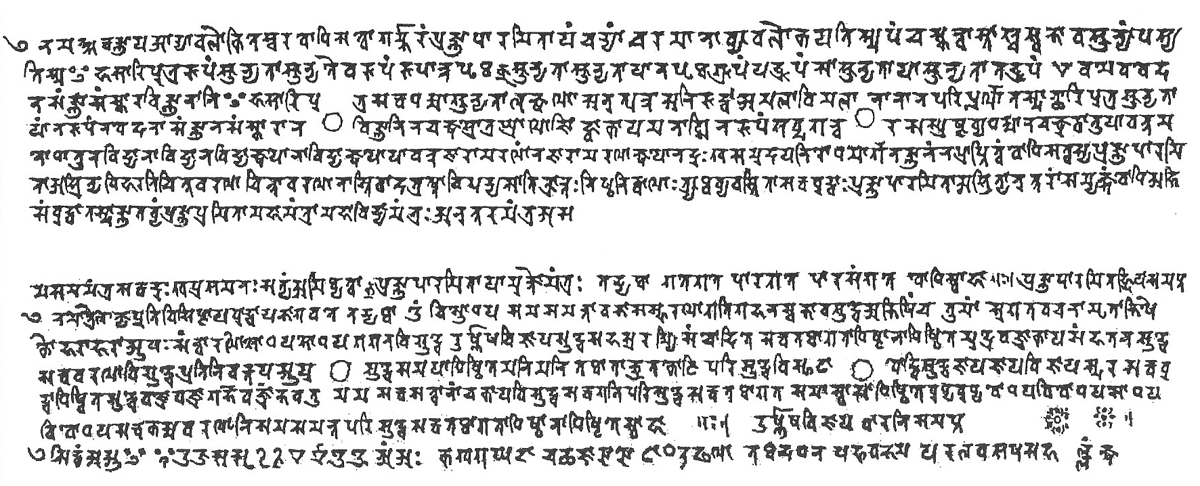
The Japan Hōryū-ji palm-leaf manuscript is the oldest known Sanskrit Heart Sutra, now held in the Tokyo Museum. Tradition holds that this copy was originally handwritten by the Venerable Kāśyapa, later transmitted by Bodhidharma to Chan master Huisi, and then brought to Japan by Ono no Imoko in the 17th year of Empress Suiko (609 CE). Monk Jōgon made a handwritten copy in Sanskrit Siddhaṃ script in 1694. Müller (Max Muller) transcribed it into Devanagari and Romanization in 1884, transmitting it to Europe and America. In 1957 and 1967, Conze collated the Sanskrit text.
Paris, the Sanskrit text collated by Feer (H. L. Feer). The original is now held at the Bibliothèque nationale de France, Catalogue No.967, a five-version parallel text in Sanskrit, Tibetan, Chinese, Mongolian, and Manchu; its Sanskrit is in Ranjana script.
_EOF_
Introduction to Buddhism: On the Prajñāpāramitā Heart Sutra~
- 本文作者:
- 程序设计实验室
- 版权声明:
- 本博客所有文章除特别声明外,均采用 BY-NC-SA 许可协议。转载请注明出处!
相关文章
大悲咒:千手千眼观世音菩萨广大圆满无碍大悲心陀罗尼经大悲神咒
介绍 大悲咒也是很常见的佛经啦,平时经常会听到的,不过我们平时听到的好像都是藏语(还是古印度语音译过来的)版本? 大悲咒(梵语:महा करुणा धारनी,转写:Mahā Karuṇā Dhāranī),全名千手千眼观世音菩萨广大圆满无碍大悲心陀罗尼经大悲神咒,又称大悲心陀罗尼(Mahā Karuṇā-citta Dhāranī)、千手千眼观音大悲咒(Sahasrabhuja Sahasran
2022-11-07 · 2019 · 约 1 分钟
「万物皆可开箱」京东京造SSD硬盘盒
之前买了那个最便宜的固态硬盘盒发现有兼容性问题。我就加 10 块钱换成这个京东京造的来试试
2025-10-28 · 存储 · 约 1 分钟
第一次体验开放式耳机,漫步者XClip开箱
十来个TWS最后都沦为电池消耗品,这次两百块买个耳夹式试水。音质确实超预期,低频却轰得人头疼;戴两小时照样不适,戴上去还没半入耳利索。至于近200MB的国产App,臃肿得毫不意外。
2026-10-26 · 音频 · 约 1 分钟
StarBlog博客开发笔记(8):分类层级结构展示
系列文章 基于.NetCore开发博客项目 StarBlog - (1) 为什么需要自己写一个博客? 基于.NetCore开发博客项目 StarBlog - (2) 环境准备和创建项目 基于.NetCore开发博客项目 StarBlog - (3) 模型设计 基于.NetCore开发博客项目 StarBlog - (4) markdown博客批量导入 基于.NetCore开发博客项目 StarBl
2022-05-24 · StarBlog博客开发笔记 · 约 1 分钟
讨论
共 0 条加载评论中…