How AI Reshapes the Labor Market: A Deep Analysis Based on Claude Data
Anthropic's report reveals that AI is primarily used for programming and writing. 36% of professions have at least 25% of tasks involving AI, with augmentation accounting for 57% rather than automation. This is more common in mid-to-high-paying jobs, while low-wage and ultra-high-wage professions use it less—quite ironic, isn't it? The data is open source, but it cannot distinguish work usage from other purposes, highlighting clear limitations.
目录11 个章节
Preface
This article is translated from "The Anthropic Economic Index" released today by Anthropic, an economic index report that summarizes the current state of AI usage based on data from Claude.
Introduction
In the coming years, AI systems will significantly impact how people work. That's why we're launching the Anthropic Economic Index, an initiative aimed at understanding the long-term effects of AI on the labor market and the economy.
The index’s initial report provides the first data and analysis based on millions of anonymous conversations on Claude.ai, offering a clear and up-to-date picture of how AI is being integrated into real-world tasks in the modern economy.
We will also open-source the dataset used for this analysis so that researchers can build upon our findings. Developing policy responses to the impending transformation of the labor market and its effects on employment and productivity requires a range of perspectives. To that end, we will also invite economists, policy experts, and other researchers to contribute their insights on the index.
The main findings from the first paper on the Economic Index are:
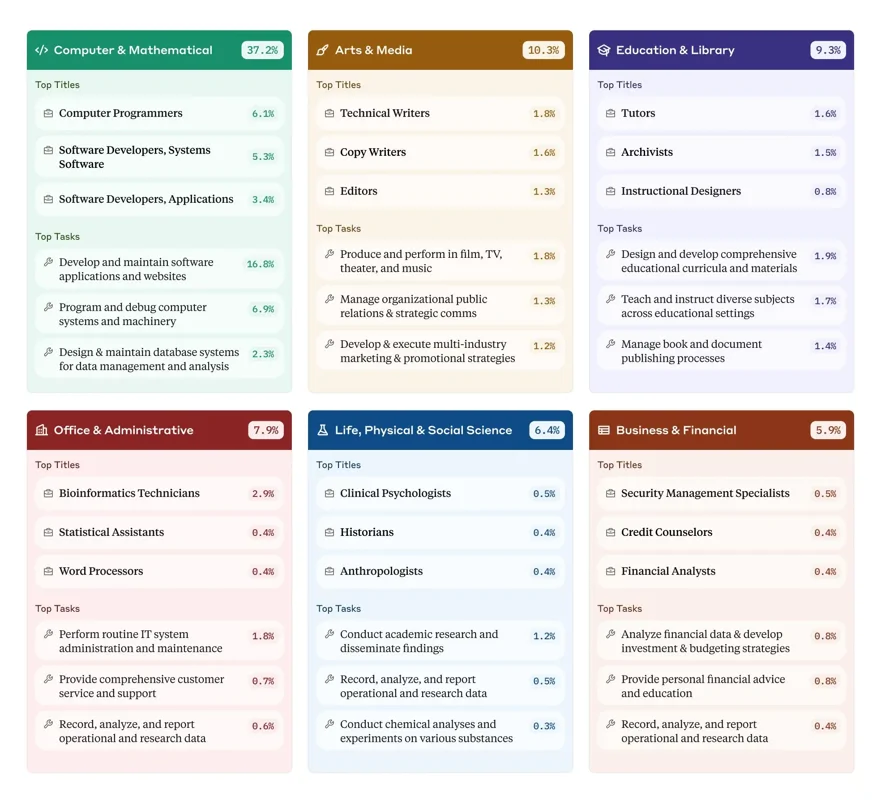
- Today, usage is heavily concentrated in software development and technical writing tasks. Over one-third of occupations (about 36%) see at least a quarter of their related tasks augmented by AI, while approximately 4% of occupations have three-quarters of their tasks augmented by AI.
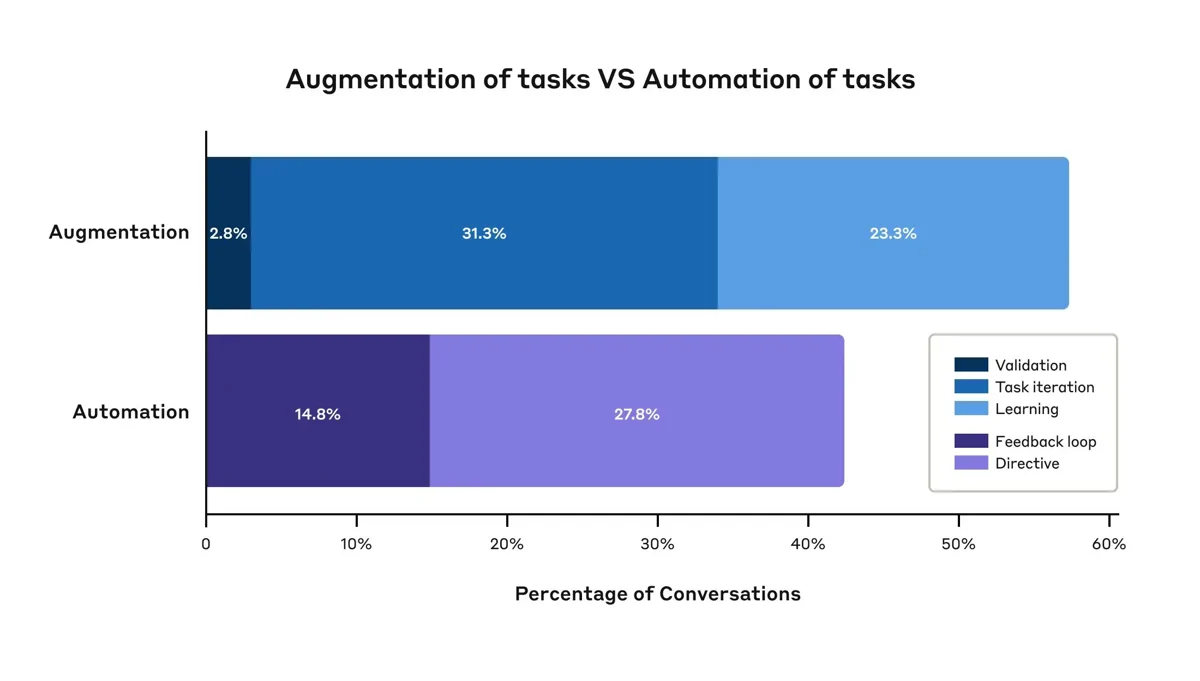
- AI usage skews more toward augmentation (57%), where AI collaborates with and enhances human capabilities, rather than automation (43%), where AI directly performs tasks.
- AI usage is more prevalent in tasks associated with mid-to-high wage occupations (like computer programmers and data scientists) and lower in the lowest and highest-paid roles. This likely reflects current limitations in AI capabilities and practical barriers to using the technology.
Below is a note on the details of our initial findings.
Mapping AI Applications in the Labor Market
Our new paper builds on the long line of research regarding technology's impact on the labor market, from the Spinning Jenny during the Industrial Revolution to today's automotive manufacturing robots. We focus on the ongoing impact of artificial intelligence. We do not survey people's use of artificial intelligence, nor do we attempt to predict the future; instead, we have first-hand data on how artificial intelligence is actually being used.
Analyzing Occupational Tasks
Our research begins with an important insight from the economics literature: sometimes it is more meaningful to focus on occupational tasks themselves rather than occupations. Jobs often share certain common tasks and skills: for example, visual pattern recognition is a task performed by designers, photographers, security inspectors, and radiologists.
Certain tasks are more susceptible to automation or augmentation through new technologies. Therefore, we expect that artificial intelligence will be applied selectively to different tasks within different occupations. Analyzing tasks—rather than entire jobs—will provide us with a more comprehensive understanding of how artificial intelligence integrates into the economy.
Using Clio to Match AI Applications with Tasks
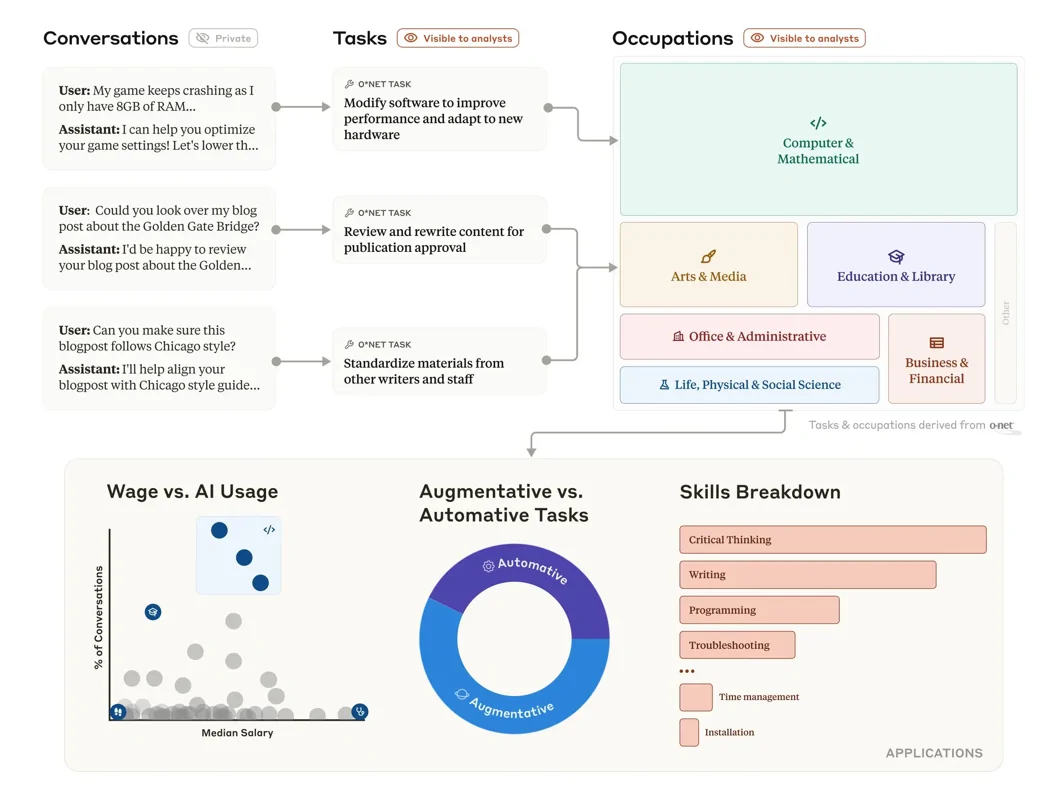
This research was made possible by the Clio system, which allows us to analyze conversations with Claude while protecting user privacy. We applied Clio to a dataset of approximately one million conversations with Claude (specifically, free and Pro conversations on Claude.ai) and used it to organize conversations by occupational tasks.
We selected tasks based on classifications from the U.S. Department of Labor, which maintains a database of approximately 20,000 specific work-related tasks called the Occupational Information Network, or ONET. Clio matches each conversation to the ONET task that best represents the AI's role in the conversation (this process is summarized in the figure below). We then follow the O*NET scheme to group tasks into the occupations they best represent and organize occupations into a small set of overarching categories: education and libraries, business and finance, and so on.
Results
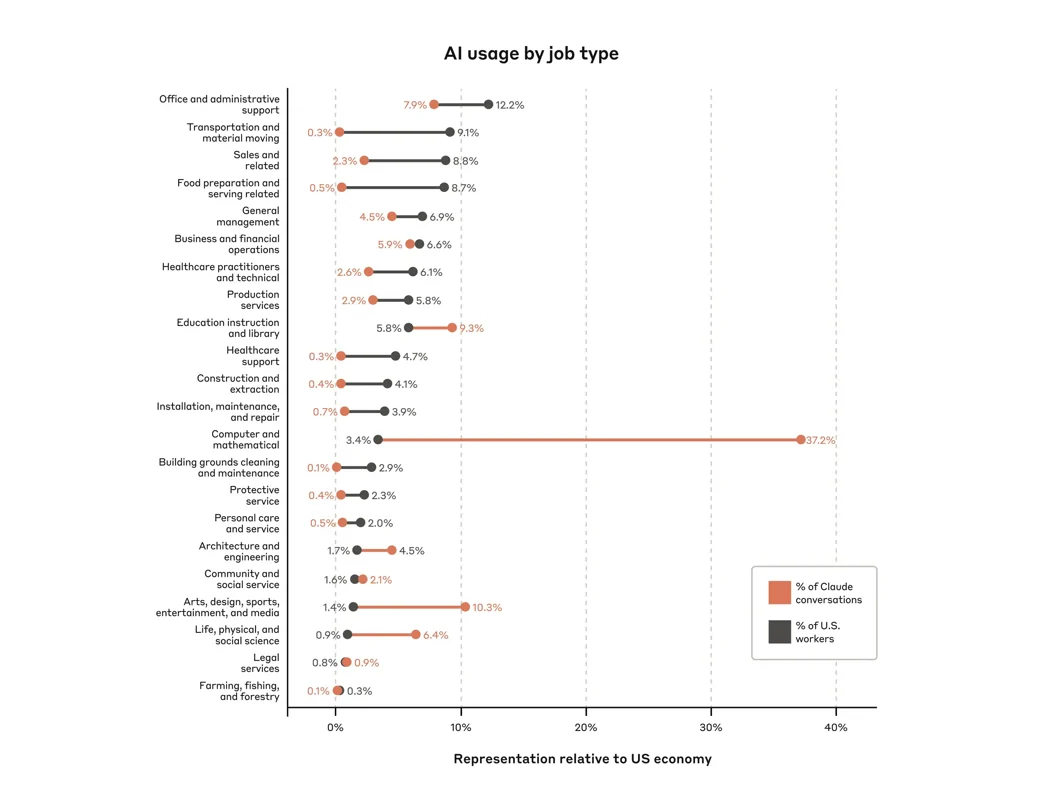
AI Usage by Occupation Type. The occupational category with the most widespread AI adoption in our dataset is the "Computer and Mathematical" category, which primarily encompasses software engineering roles. 37.2% of the queries sent to Claude fell into this category, encompassing tasks such as software modification, code debugging, and network troubleshooting.
The second largest category was "Arts, Design, Sports, Entertainment, and Media" (10.3% of queries), largely reflecting people using Claude for various writing and editing tasks. Unsurprisingly, occupations involving highly manual labor, such as the "Agriculture, Fishing, and Forestry" category (0.1% of queries), were the least represented.
We also compared the rates in our data with the rate at which each occupation appears in the overall labor market. The comparison is shown in the figure below.
Depth of AI Use in Occupations. Our analysis found that few occupations extensively use AI across their related tasks: only about 4% of jobs have at least 75% of their tasks utilizing AI. However, moderate use of AI is more prevalent: approximately 36% of jobs have at least 25% of their tasks utilizing AI.
As we predicted, there is no evidence in this dataset of complete job automation: instead, AI has diffused across many tasks in the economy, with stronger impacts on certain task clusters than others.
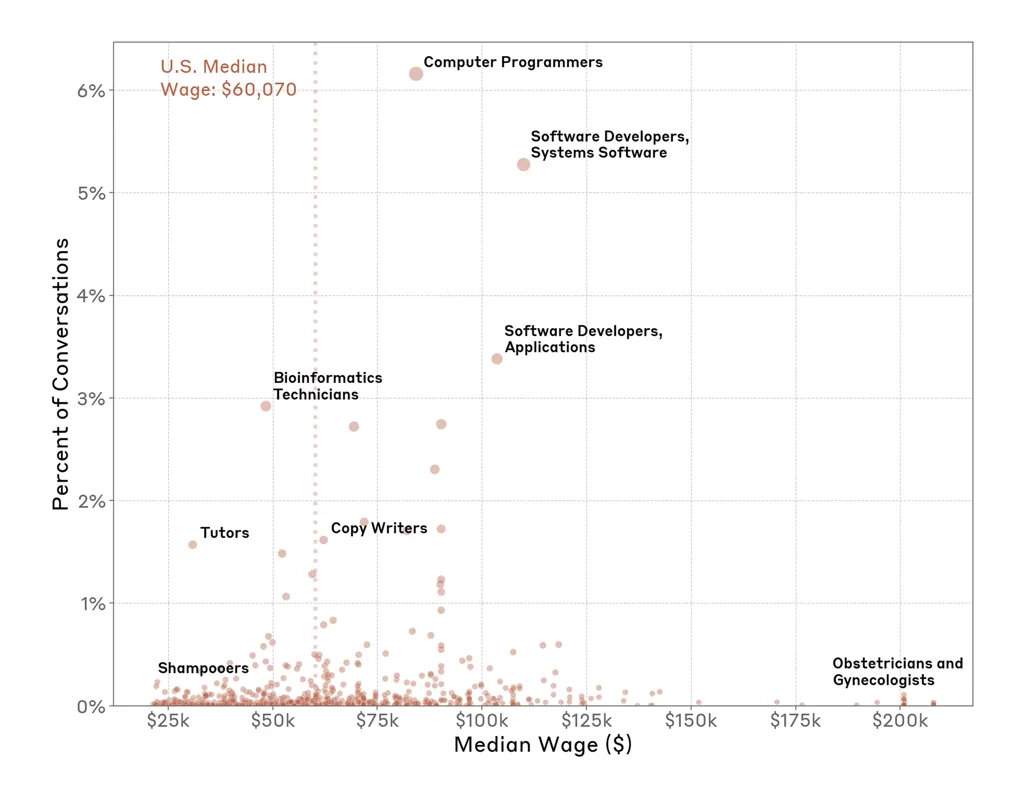
AI Usage and Salary. The O*NET database provides median salaries for occupations in the United States. We incorporated this information into our analysis, allowing us to compare the median salary of various occupations with the level of AI usage in their corresponding tasks.
Interestingly, both low-paying and very high-paying jobs show very low rates of AI usage (these are often jobs involving significant manual skill, such as shampooers and obstetricians). In our data, the most frequent users of AI are specific occupations at mid-to-high salary levels, such as computer programmers and copywriters.
Automation vs. Augmentation. We also looked more closely at how tasks are performed—specifically, which tasks involve "automation" (where the AI directly performs the task, like formatting a document) versus "augmentation" (where the AI collaborates with the user to complete the task).
Overall, we observed a slight tilt toward augmentation, with 57% of tasks involving augmentation and 43% involving automation. That is, in more than half of cases, AI was not being used to replace the person performing the task, but rather to work alongside them, engaging in validation (e.g., double-checking the user's work), learning (e.g., helping the user acquire new knowledge and skills), and task iteration (e.g., helping the user brainstorm or perform repetitive generative tasks).
Important Considerations
Our research offers a unique perspective on how AI is transforming the labor market. However, like all studies, it has significant limitations. These include:
- We cannot determine whether individuals using Claude to complete tasks are doing so for work-related purposes. Someone asking Claude for writing or editing advice might be doing it for work, or for a novel they are writing as a hobby.
- Similarly, we do not know how users utilize Claude's responses. Do they, for example, copy and paste code snippets? Are they verifying the responses or accepting them uncritically? Some of the automation apparent in our data may actually be augmentation: for instance, a user might ask Claude to write a complete memo (which appears like automation), but then edit it themselves (which would be augmentation).
- We only analyzed data from Claude.ai Free and Pro plan users, not from API, Team, or Enterprise users. While Claude.ai data includes some non-work-related conversations, we used a language model to filter the data to include only those related to occupational tasks, which helps mitigate this concern.
- The vast array of different tasks means Clio may have misclassified some conversations (see the full paper, particularly Appendix B, for specific details on how we validated the analysis).
- Claude cannot generate images (except indirectly through code), so some creative uses may not be mentioned in the data.
- Given that Claude is promoted as a state-of-the-art coding model, we might expect coding to be overrepresented as a use case. Therefore, we do not believe the use cases in our dataset represent a general sample of AI applications.
Conclusion and Future Research
The use of artificial intelligence is expanding rapidly, and the capabilities of models are growing. In a relatively short time, the state of the labor market may look quite different. Consequently, we will repeat many of the analyses presented above over time to help track the social and economic changes that may occur. We will regularly publish results and relevant datasets as part of the Anthropic Economic Index.
This type of longitudinal analysis can provide new insights into AI and the job market. For example, we will be able to monitor changes in the depth of AI use within occupations. If AI remains confined to certain tasks and only a few jobs use AI for most of their tasks, the future may be one where most existing jobs evolve rather than disappear. We can also monitor the automation versus augmentation ratio, providing signals for areas where automation is becoming more prevalent.
Our research provides data on how AI is being used, but it does not offer policy recommendations. The answer to the question of how to prepare for AI's impact on the labor market cannot come directly from isolated studies; instead, it will emerge from a combination of evidence, values, and experiences from a broad range of perspectives. We look forward to using our new methodology to gain a deeper understanding of these issues.
Read the full paper (Translator's note: The paper is at the end of the document) for more details on our analysis and results.
Open Data and Call for Feedback
The most important contribution of this paper and the Human Economic Index (人类经济指数) is its new methodology, providing detailed data on AI impact. We immediately publicly share the database used for the above analysis and plan to continue sharing as more datasets become available in the future.
The complete dataset can be downloaded here. (https://huggingface.co/datasets/Anthropic/EconomicIndex)
A form for researchers to provide feedback and suggest new research directions is available here. (https://docs.google.com/forms/d/e/1FAIpQLSfDEdY-mT5lcXPaDSv-0Ci1rSXGlbIJierxkUbNB7_07-kddw/viewform?usp=dialog)
Acknowledgments
We thank Jonathon Hazell, Anders Humlum, Molly Kinder, Anton Korinek, Benjamin Krause, Michael Kremer, John List, Ethan Mollick, Lilach Mollick, Arjun Ramani, Will Rinehart, Robert Seamans, Michael Webb, and Chenzi Xu for productive comments and discussions on early findings and drafts of the paper.
Original Text
Original Source URL: https://www.anthropic.com/news/the-anthropic-economic-index
Paper: https://assets.anthropic.com/m/2e23255f1e84ca97/original/Economic_Tasks_AI_Paper.pdf
_EOF_
How AI Reshapes the Labor Market: A Deep Analysis Based on Claude Data
- 本文作者:
- 程序设计实验室
- 版权声明:
- 本博客所有文章除特别声明外,均采用 BY-NC-SA 许可协议。转载请注明出处!
相关文章
AI画图-StableDiffusion
前言 最近AI很火🔥,先是AI画图,然后就ChatGPT,后者我已经用了一段时间了,用来写作文挺不错的,但OpenAI屏蔽了中国IP,加上用户太多啥的,用起来没那么爽,但没办法全球只此一家,只能捏着鼻子用。而AI画图就不一样了,全是开源的,自己部署一下可以玩个爽~ 正好我们这有台2080Ti的工作站,之前用来训练模型的,现在部署个画图应该轻轻松松,于是就开始了折腾之路~ 效果 先看看我生成出来的
2023-04-23 · AI-炼丹 · 约 1 分钟
你的显卡能跑多少算子?用 55 个检查项,给 PyTorch GPU 环境做一次冒烟测试
一个破脚本能测的只是输出是否还在cuda上,跟真正的gpu性能有个毛线关系。跑出来54/55的“通过率”就敢吹ROCm完美?麻烦先去搞清batch_norm为什么挂,再看看你那些操作到底调了哪个后端的kernel。
2026-05-20 · AI-炼丹 · 约 1 分钟
LCD 手机老兵不死:iQOO Neo5 活力版降级 OriginOS 1 的一天
四年前的iQOO Neo5活力版还流畅?活该vivo售后劝降级时一脸懵逼。自己动手降级到OriginOS 1.x才叫本事,还特么要自己找旧版App?这手机明明够用,非要作死逼人换新机。
2025-11-14 · 2025 · 约 1 分钟
IT之家学院:让你的Win10桌面比macOS还简洁漂亮高大上
感谢IT之家网友 yiyueduzui 的原创投稿 直奔主题,先给大家看看我的电脑桌面: 有人开始骂了:你特么逗我呢?这明明就是一张图片好不啦! 我读书那么多,怎么会骗你,这真的是我的电脑桌面,不还有个桌面数字时钟呢嘛!论简洁,还有谁? 那这啥都没有,要怎么用啊? 看好啦,当我的鼠标移动到屏幕下方的时候, 出现了一个Dock栏,跟苹果系统的一样一样的。 有些图标其实是一个目录或者文件夹,当它展开的
2021-12-18 · Windows · 约 1 分钟
讨论
共 0 条加载评论中…